
Violinist and Composer Che Ali grew up in Crown Heights, Brooklyn, in a house filled with art and music. Their mother, a visual artist; their father, a hip-hop producer. Classically trained, but often criticized for being “too loose” with Bach, Che’s trajectory has been one of quietly refusing definition.
HOPE: Where do you find yourself right now? I know you’re in Berlin, but in the larger context of your outer world into inner world, however you want to dilate that…
CHE: I’m in Berlin. I’ve been coming almost every summer since 2023. The first time was for a performance, I was only here a week, and I fell in love with the energy. The city has such a nice balance between the edginess and busyness I find in New York and a lot of beautiful green space: real opportunity to find peace. It’s funny, because whenever people talk about Berlin, everyone says, I’m going clubbing. And I like Berlin for the exact opposite reason. It takes from the excitement, the vibrant artist scene, but there’s also a lot of space for something more quiet.
I’m here now working on music. I’m coming out with my new album, hopefully by the end of this year; I did some recording a couple of months ago and I’m finishing up the writing for it. So this is basically a self-directed artist residency.
HOPE: That’s amazing, and hard to do. I want to be careful with my question so I don’t guide you into a corner, because I’m really curious what your method is... How do you find that process unraveling? In my own practice I start with an assumption of a structure that will work, and very quickly find it has nothing to do with reality... By the end I’ve gone through many methodologies and it’s still a mystery to me. What have you found helpful?
CHE: I relate to that. Many times I go in thinking there’s going to be some structure, some formula to follow, and then find out it usually doesn’t work. These days it’s about embracing all the things that go into the creative process. Sometimes that means taking walks and thinking about the concept, what intentions I want to be surrounded with. Sometimes it means taking out the instrument for a short time and focusing on one aspect of something. Sometimes it’s journaling. All of it helps you get to the destination of the piece. And consistency: I’ve been trying to engage with the creative process every day, but gently, balancing spontaneity, how I feel on a given day, with steady engagement. I also took a break from creating for a couple of weeks, and that helped too. Now I’m very motivated to create.
HOPE: What I hear is an attunement to your own instrument, which is hard to do right now. I think it’s the quiet revolution. I’ve noticed artists doing it in different ways, but the common denominator is choosing the right location for your needs. Each person is like a different plant: I need this much sunlight, this much quiet. There used to be this idea that if you want to make it, you move to New York or LA. What I notice now is artists saying: for my instrument to function correctly, I need to be near a mountain, near the ocean, around this much light. People are getting more attuned to whatever that thing is, regardless of what cultural logic says is the correct move. Do you have a name for that feeling? That resonance, this feels correct for this season of my life, coming from your own sensory system rather than outside in?
CHE: Attunement definitely makes sense. But I also just think intuition. It’s been coming up for me a lot: really tapping into it and trusting it as something that exists in all of us. Because in society in general, and in musical training, every external force is telling you not to. Telling you to disconnect yourself from yourself, in all ways. So attunement, intuition, the internal compass: it all matches.
Attunement, intuition, the internal compass: it all matches.
HOPE: What are examples of ways that has happened for you? Moments where a person or an institution is asking something of you, and you have the quiet, steady no?
CHE: If I reflect on my path as a violinist, as a musician (maybe you relate to this, having interacted with classical forms of making), there’s a lot of imposing ideas on a person. And there’s always been some kind of alternativeness in me, something hard to define. When I was much younger, it looked like this: I would study all this Bach and repertoire, but on the side I was always making up my own stuff. And I was often criticized for being too loose in my interpretations. When I got older, taking on composition in the middle of my violin training was another way of becoming hard to define. I’ve seen these patterns all through my trajectory, signs that I’m rejecting what institutions and cultures try to impose on me. And it’s continuing to happen. Over time it’s about embracing these things: seeing what a huge difference it makes when you’re doing the stuff that feels right, maybe different from everything you’ve been taught, but the most empowering.
HOPE: I like becoming hard to define, the art of becoming. That daily relationship with creativity: watering something, seeing how it grows if you take care of the conditions. And the hard-to-define part is the thing that, at least in my experience, gets sidestepped by mentors, all very well-meaning people. The intention is, I want you to be safe out in the world and have opportunities, so you have to define this, you have to fit in these ways. It becomes a fear tactic, even from the best intentions. And in those conversations there’s an unspoken rule that the mentor gets the last say, whether the mentor is a person, an institution, or an organization. But there’s something about this time in history where nobody knows, and the balance of that conversation has to shift. One of my heroes is Thich Nhat Hanh. He did a lot of peace and reconciliation talks, and he always said: in a true dialogue, both sides are willing to change. Can you imagine what the artistic community could be if we reset the job descriptions around true dialogue?
CHE: That’s such a good point. It reminds me of a residency retreat I did at Antenna Cloud Farm in Gill, Massachusetts, called The Experiment. One of the first things reestablished in that space was challenging the whole mentor and mentee relationship. The point was to process our experiences in musical training and imagine what a new model for music education could look like, incorporating liberatory, anti-colonial modes of thinking. That hierarchy is usually one-sided and ends with the mentor taking the last say. If we all approach it with the idea that we’re navigating this world together, that we don’t know what is to come and need to figure it out together, that’s a relationship of true dialogue, where things are really equal. Not coming in as if I know everything and you need to listen to me. Even with masterclasses: imagine if that whole model changed, and it was just a conversation. How do we interpret this? There’s no right or wrong. Let’s hear each of our inputs. It’s a more expansive and much more productive way of living in this world. Because things are very dire and unknown.
HOPE: I think a lot about resourcedness. Challenging conversations require a lot of inner resource. I used to run an experimental ensemble, and my people were working fifteen gigs, sometimes eating one meal a day, rent the biggest thing on their minds at all times, and then they’d come to rehearsal and I’d say, give it all, go to the edge. And I realized: that’s not right. They’re not resourced enough to go to the edge. That’s a big part of why I went back to school. I needed time to figure out how to create an environment in which that’s an appropriate ask. How does that come up in your own collaborations, the right-sizing of the expectation?
CHE: That’s so real. What does sustainability look like in our society, when everyone’s resourcing is different? Honestly, it’s something I need to think about more: in collaboration, how to take into account people’s capacity. Especially in a place like New York. Being in a doctorate program is a fortunate model, because you really have permission to explore ideas. It’s very precious, this amount of time while having a stability you’re not sure you’ll have after you graduate. I do try to have these conversations with fellow artists: how do you put yourself in places that give you leverage for exploring things? When you do that, your priorities change. Residencies and degree programs may just have more longevity than chasing a hundred gigs, and when you put the focus there, you do a lot more self-discovery. Because right out of school, you’re just trying to make ends meet, so you take on a bunch of things. It’s great to have opportunities, but seventy-five percent of the gig-taking stuff is unmeaningful. It isn’t fueling me artistically; it’s only paying the rent. So it goes back to environments: finding the one that gives you space for the things that are actually meaningful to you. It’s easier said than done. In our highly capitalistic society, things get so blurry (what my intentions are, what is actually calling me) because the cost of survival is so high.
Seventy-five percent of the gig-taking stuff is unmeaningful. It isn’t fueling me artistically; it’s only paying the rent.
HOPE: There’s a mass hypnosis you have to tap out of as an artist. And the pull is so strong that it’s easy to find yourself sucked back in without realizing. Wait, how am I here again? I thought I escaped this. You can escape for a day at a time, sometimes.
So I’m curious: is your family musical? What’s the vibe of how you grew up?
CHE: Most of my immediate family is creative. My mom’s a visual artist; she works primarily in photography, and also with fabrics, installations, a lot of video. My dad is a musician: a hip-hop producer and rapper, and an educator as well. My older brother sings, plays guitar, and produces his own music. My younger brother just picked up guitar, raps, and produces too.
HOPE: So are you your mother’s child, temperamentally?
CHE: I’d say a mix is most accurate. My mom is the more experimental and abstract one, though my dad in some ways too. But the clear musical traits come from my dad’s side.
HOPE: Did he have a home studio growing up, a room in the house where production was always happening?
CHE: Yeah: that, and the insane record collection. Being exposed to all types of music was formative for my whole musical upbringing. The house was filled with music at all times.
HOPE: What’s a specific memory of a record? Are you an obsessive listener like me, one record, five thousand times?
CHE: It really spanned all genres. I was very fixated on Radiohead, a lot of the earlier albums. But there are also a bunch of things I don’t know the name of, just the sound worlds. My dad would spend periods of time on certain things for his own work, sampling and so on, and I think the way memory works in my music came from that immersion.
HOPE: Would you ever make a record with him?
CHE: Oh yeah, we’ve definitely talked about it. I’ve collaborated with all of my family at this point, pretty extensively. I would totally love to.
HOPE: Where do they live?
CHE: In Brooklyn, in Crown Heights. I live in the same place I grew up.
HOPE: That’s so special. What a strong bass line your family and upbringing is. That seems like an obvious statement, but I forget it constantly; I have this baseline assumption that I’m an individual with my individual dreams, and I’m humbled over and over by the fact that I’m a product of my environment. As you were speaking I was remembering that I often tell people my stepdad’s record collection raised me. He’s not a musician, but he traveled a lot as a young person and collected music everywhere, so I was listening to records from all over the world very young. There was no distinction between our music and their music. And one birthday he got me this huge set of all the Putumayo records ever made, so I inherited whole archives of world music as a kid. I travel constantly now, but it’s an inherited thing. Someone opens the door and it becomes self-evident. In your environment, the self-evident open door is this wide field of influences. If someone told you those things don’t go together, conceptual art practices and hip-hop, you’d say, what do you mean? They lived in my same house.
CHE: Exactly. How formative family and ancestry are is a huge thing. The mix I grew up exposed to explains this desire not to conform, not to feel such strong pressure to define my practice. All of it created this expansiveness.
Actually, I’ve been meaning to ask you. I’m so curious about all the traveling you do, and how you’ve approached collaboration in the places you’ve been. You go to such different places and find community in all of them. On a practical level, how do you literally meet all of these people? And what has collaboration looked like, and how do people respond?
HOPE: These are such good questions; I’ll only get to a portion of them in the time we have. A few things came to me as you were speaking. One: I’m naturally an outsider everywhere I go. My family moved a lot when I was little, maybe every year for twenty years, a new place. Though I have a brother who had the same experience and responded in the opposite way; he wants extreme stability now. So who’s to know the exact chemistry.
But my background is so crazy. I present a certain way (right now I’m a white girl in an Ivy League PhD program) and there’s a lot of plastered-on assumption about who I am based on that, which I have no connection to. I’ve made some artwork about this: my birth parents were match-married in a cult. They gave up all their possessions and lived in communal housing and worked menial labor jobs while doing spiritual fasts. The things you have to do to be in that situation are pretty intense. You give up your family connections, because cults sever you from family as a way to isolate you, and you give up the whole cultural hierarchy of money and possessions being the most important thing. You literally hand it all over. I’m not saying these things are good; there’s a lot of dark there. But it set an interesting foundation: being born into a very different way of looking at reality, in an outsider context. And basically once I was born, my family escaped. So there’s this Phoenix-from-the-ash beginning: here’s this very different foundation and sense of the world you’re born into, and the minute you’re born, it all falls apart.
There’s a kind of therapy for people coming out of certain religions, a process almost like deprogramming, and a lot of people say that once you start deprogramming one thing, it’s impossible to isolate it to one part of your life. You don’t just deprogram Christianity or Mormonism from your psyche. Suddenly you look at everything and ask: well, what if that’s not true? What if that’s not the full truth? Relationships, sexuality, intellectual pursuits, what is knowledge? Maybe knowledge is not what they say it is. So it’s a very interesting Petri dish that the cell of Hope Littwin was arranged inside of. It set a lens of questioning authority to a degree I don’t see a lot of other people actually doing. And I’m really grateful for it, even though it came at a lot of cost. What an amazing jewel to be left with through epigenetic trauma. Your gifts are inside that: the jewel in the mouth of the monster. I hold that pretty close.
So when I look at, say, New York City, the imposed hypnosis of these are the popular people, these are the important people, associate with this and you’ll get this, I’m already looking at the story as a story. I get pulled in too; I’m not unaffected. But having the lens of these are all hypnoses, and a lot of them are hierarchies of power and influence, lets you ask: how else could I view power? Someone taught me the word bricolage yesterday: making something with whatever’s around. It’s more like: you’ve told me this person has power and I have to associate with them. But what if I open my sensory system to the power in this person, the mailman? What if the mailman has a beautiful artistic practice? One of my favorite questions to ask people when I first meet them is: what is your dream? No one asks that. I’ve had people cry who’ve never met me, just because I asked. They say, I haven’t thought about it. What is my dream? There’s so much magic everywhere, and we’re all taught to look in one direction for it, the magic’s over here. And I’m like: the magic’s everywhere.
As for the places I go: a big part is intuition. I’ve been practicing going where I’m called, and my experience is that land calls me. I’ve had experiences where the name of a place appears in my consciousness and I don’t even know it’s a place; I have to Google it. I interpret those as calls. And I’m not someone who needs a lot of proof; the proof is the landing in my psyche. If someone says, that’s not technically how it works, you must have seen the name in childhood: fine, I don’t care. It makes no logical sense in my current situation, but I’ll follow the resonant frequency cues. Then the second part is economic: can I afford it, or can I find somewhere close enough that I can handle? There are practical adjustments.
And I’m amazed how much people open up to you when you’re open and curious about them. I show up in someone’s land and put out the feelers: I’m Hope, I come in peace, I’m this very bizarre musician open to some kind of musical dialogue, and it doesn’t have to take any specific form. I’m interested in what might happen if we gather. It’s self-selecting: whoever responds to a message like that already has a certain openness. And then often I get really schooled. The experiences make me question my own assumptions constantly. It’s not the classic model we’re taught: go to this part of the world, make your piece, they’ll play your piece. I get economically why people set that up, but when you really look at it, is that collaborating? It’s so strange. There’s so much unknown involved that it’s hard to write grants, for example. I’ve had to learn a special language: here’s what I can say, and here’s the huge realm of unknown, and the point is to protect it, an open, held space for the magic to occur. Maybe it happens, maybe it doesn’t, maybe it happens completely differently than I assumed. Even in my relationship life: what can I promise, what can I not promise? Because the way my system operates is not on the grid of normalcy.
CHE: That’s so intriguing. It’s a prime example of tapping into the unknown, and there’s a certain openness everyone involved has to have. I’ve always found that interesting about you. It’s such a rich way of living, so much to take in and learn. Has there been one place where you found a very specific resonance?
The magic’s everywhere.
HOPE: What came to mind first was Mexico. Mexico is another planet, the nature there. There are studies on the geology; huge caves full of enormous crystals living under the earth. It’s an alternate universe in the plant life alone, and what comes out of that is that the people, raised in this environment of magical realism, live where the veil is very thin. In Mexico it’s very dark feminine, and death is right here. Everything feels like a portal, which is maybe true everywhere, but it’s so loud there, so palpable. This is where the connection of land and people gets interesting: what the environment offers, people develop into language, into methodologies, into their sense of the structure of the world. So ideas that here read as very experimental or out-there are, there, self-evident. You don’t have to convince anybody about another dimension, or the realm of intuition, or that the dead walk with you. All these realms are alive at the same time. I feel very comforted in environments where you don’t have to explain or defend them. I had beautiful experiences in both Oaxaca and Mexico City, especially the Oaxacan coast, because I’m an ocean baby.
And then Lithuania. I have epigenetic heritage there. It wasn’t discussed much, my family’s kind of a lost history, but my name literally means man from Lithuania; I’m named for a history no one talks about. And I felt called. I work with a Hungarian shaman, and over many years we did consistent practices (breathwork ceremony, trance-state work, very held) around building ancestral connection and communication. In one of those ceremonies an ancestor, it felt like seven generations back, very old, came to me and told me to come to Lithuania. So I thought, okay, I guess I buy a ticket. What are you going to do, not buy a ticket?
I stayed in Vilnius, and only once I arrived did I learn they used to call it the North Jerusalem; it was an epicenter of the intellectual Jewish community. In the old town there were at one point something like a hundred and twenty-eight temples; now there’s one. Some historians say the Holocaust started there. I didn’t seek that information out; it came to me. I’d walk around the city, see a plaque, Google the plaque. I was caught in a rainstorm, ran into a store, and ended up meeting one of the town’s top Jewish scholars because we were both kept out of the rain, and he gave me the whole history. They wiped out some ninety-seven percent of the Jewish population there before it spread. And there were people who escaped and survived in the deep Baltic forest, a guerrilla resistance of forest people. That must be some form of the history I tapped into.
And the land was very communicative with me there, in really intense ways. One of the places I stayed in the old town was a dugout apartment that went down into the earth, and the day I got there, legit gnomes came to me. I’ve never seen a gnome in my life. Maybe it was an elf, some kind of elf-gnome situation. And they were pissed. Not at me, but pissed and trying to communicate. And I was scared, because an encounter like that feels almost violent: I don’t know what to do with this information right now. Ultimately the message was: someone very important to us is buried here, and whoever dug here did not have permission. And I’m thinking, I don’t live here! But I asked the owner, testing how open he was: did you build this place yourself? Did you have to dig out the bottom floor? He said yeah, it was a really big job. And when I mentioned I’d had some spiritual visitations, he said, well, I’m glad you have friends. Okay; conversation shut down. But isn’t it interesting: some blood-body-gene connection to an environment so intense that you land there and the literal elf realm of your epigenetic country says, okay, now that you’re back, we have things to discuss. Some kind of DNA memory. I still intellectually go, how can that be true? But I physically experienced it. And with the musicians in Lithuania it was instant connection, an ease of communication on levels that take more effort elsewhere. In the Baltics people don’t do small talk; they’re not interested in niceties, which I find very comforting, because I’m a very direct person too. I get in trouble for it all the time in the United States. There, I think: oh, everyone does that here. I can unmask. I’m so relaxed.
CHE: There’s definitely a lot to be said about these connections with the land. If you look at indigenous practices in the States and all over, people knew how to communicate with the land, what these things mean. As you were talking, it reminded me of my mom and some of the work she does around ancestral memory. My mom’s side of the family is from West Africa, from Sierra Leone and Guinea. And my mom and my grandmother went to South Carolina, to Hilton Head, where the Gullah Geechee people are from, and my grandmother immediately noticed such a strong connection to the Mano River in Sierra Leone. They both felt: wait, this is like there. So these things really exist.
And I actually just went to Lithuania a couple of weeks ago.
HOPE: That’s right! Did the gnomes speak to you?
CHE: During that trip I didn’t communicate with any. But it was the most interesting place I’ve ever been; I’ve never been anywhere like it. Just being in the Baltic region is so beautiful. At the end of the trip I was at a music residency near the Ventės Ragas cape, right on the coast and lagoon of the Baltic; I’ve never experienced beauty like that. I was in Vilnius at the beginning, and Klaipėda for a couple of days. I really wanted to get to Nida, the place you recommended.
HOPE: Nida is a very healing place. There’ll be more opportunities.
This connects to something from earlier: being guided, and resonance. One of the books I’ve been spending a lot of time with is Morphic Resonance by Rupert Sheldrake. He’s a scientist, though his wife is a musician and both his sons are musicians. I’m very interested in fields of resonance, the idea that the way we’ve been taught to think about ourselves is very isolated. One of the beautiful things I found in the Baltics is that a lot of the folk songs are written for certain places in nature: this song is sung in this cave, this song is sung in this field. So there’s an immediate understanding that resonance is more than me and a chord; it’s not one-three-five. Resonance is tuning into a field that has to do with everything outside of you and how you’re connected to it. Sheldrake says we have this idea that DNA is ninety percent of who you become, and he suggests it’s more like twenty: that there’s a field of influence around you, almost like an energetic embryo you grow into. What surrounds you shapes who you become, far more than the physical body, these invisible fields suggesting a certain form, a certain shape.
I was at the pool the other day, dripping water and watching the ripples go out, and I thought: that’s what sound looks like. Fling a bunch of water and all these ripples interfere with each other, creating patterns. That’s the reality of a sonic experience, happening all the time, all the time. And our entrapment in linear thinking: even horizontal processing is still on an axis. We all think the universe is orthogonal: lines, roofs, right-angle walls. It’s not reality. It’s an invented structure for a sense of safety that doesn’t exist. And I’m okay with playing in that field, if we say: hey, we’re going to play a game, and the game is orthogonal universe. Let’s go. But remember it’s a game, and there are many other games. I’m not anti-institution or anti-classical-music or anti-whatever. It’s just: okay, you want to play the game where melody is linear and chords are vertical and that’s the grid? Cool, let’s play. But next, can we play the game where sound is nonlinear, and you never know what encounters will happen until they do, and the interference has to be responded to?
CHE: I one hundred percent agree. It’s about embracing the nonlinearity of things and seeing how they feel. Once you start tapping into that, you see how things open up, how much unknown there is. The infinity of it all is what’s interesting.
The infinity of it all is what’s interesting.
HOPE: This process of dilation as an artist is really interesting to me. In different eras of my life I earn the capacity to be open to more completely bizarre experiences. And I realize there are probably many more I don’t currently have the capacity for, because I couldn’t handle what they would mean for my view of the universe. If I think about a trajectory for my life (unfortunately for everyone around me who wants it to make more sense), it’s: continue to dial it open. Surprise me, surprise me. It’s amazing what comes in. The world’s a wild place if you’re open and willing to participate. And then you go home and say, this happened, and people say, that’s not possible. Well, I experienced it, so I don’t know what to tell you.
But how do you handle the body side of that? I think staying open has more to do with nervous system capacity than mental capacity. My body has to reimagine its relationship to reality every time a new encounter is met, and it’s the physical shutdown the mental shutdown responds to: that’s too much voltage for me, that’s too new for me to feel safe accepting. You do a lot of experimental work. What does that processing look like for you?
CHE: That’s a good question. For me it’s slowness: taking things in gradually, in small increments. A slow unfolding rather than jumping in all at once. Sometimes the all-in happens anyway, without being able to control it. But I try to give myself time to process, regulate, adjust, zooming in on the adjusting period and letting it take the time it takes.
HOPE: Do you have physical responses? I’ll be in a situation I want to be in, conducting a new group, say, and my body is physically shaking, and there’s nothing I can do to stop it. I’m aware I want to be here, this is ultimately good, and my body is freaking out.
CHE: That happens to me too. I definitely relate to the literal shakiness. Or suddenly I’m playing something and I notice, I’ve never made that mistake before; this has never felt this way before. Usually, after processing it, the body goes: okay, this is what we’re dealing with now, and it gets better over time. Focusing on the breathing helps. And a lot of mental anticipation: imagining myself doing the thing as vividly as I can beforehand. Since most of my art-making now happens on my own terms, the experience is generally easier to hold. But during the Lithuania performance (it was the first time I wrote a piece for myself as soloist with a string orchestra, and there’s a lot of experimentation in it) I was thinking: are these people going to be receptive to my ideas? There was a lot of new adjusting. The anticipation helped, and then just giving yourself grace: this may take a couple of days.
HOPE: That’s beautiful. And isn’t it amazing to think that all of the people we look up to had the same experience? They presented something they were physically shaking to present, and now it’s core to our musical history, that work they weren’t sure anyone would accept. One of my mentors handed me the mantra take the hit, and I carry it everywhere. If I’m going to be a leader in my life, maybe in a community, my job is to take the hit. People didn’t like that? That means being receptive to feedback that doesn’t feel good, being wrong. That’s what happens in the world of truly offering something new. People ask me, how do you stay so confident, how do you just put your ideas out there? And I think: that’s what’s happening behind the closed door. It’s not confidence the way you think. It’s a willingness to take the hit when people inevitably push back. Which is so uncomfortable, especially as a very sensey baby. But it’s good to remember that the people doing the work you admire are still having the experience you described: on the surface, I premiered a solo with this beautiful string orchestra, and what was also true was, I was really scared and I wasn’t sure it was going to work, but I showed up anyway.
CHE: I love that mantra. And I do wish more people could be open about the process, everything that goes into it. There are definitely people who are vulnerable and share, but thinking again about figuring out the world together: that openness is a model for how to navigate the world when none of us really know. I wish there wasn’t so much stigma about nerves, this practice of putting up facades all the time. It’s so prevalent in our field and in society in general, and social media only exacerbates it.
It’s not confidence the way you think. It’s a willingness to take the hit.
HOPE: We should say: the reason we’re talking right now is that I put out a kind of sneaky Instagram video, which I took down right away, where I admitted that I honestly dissociate at most concerts. And you were like, oh my God, me too, and a lot of other people said the same. Do you want to talk about your experience with concerts and attention?
CHE: We’ve touched on some of it: the distraction, the hypnosis. Everyone is so concerned about the wrong things. Everyone’s trying to be close to this person to get benefits, and then I wonder, why are we here in the first place? Did we just experience a concert? Did you listen to what I just listened to? Everyone is fascinated with the technical stuff, everything that isn’t related to the spiritual part of music, the thing that’s actually transcendent. The places where I have had those experiences are usually performances that are more multidisciplinary, where participation is part of the form, where the performers invite the audience to be part of the thing. That makes less room for passiveness and less focus on the superficial. But in the majority of new music concerts, the traditional audience-to-stage model, so much gets lost in translation. People are concerned with the surface because that’s their limited understanding of how things should be.
HOPE: And maybe what they feel they can control. I find in my own life, when I’m moving apartments, the experience is so overwhelming that I catch myself not packing boxes but organizing my toothpick collection, because that’s what I can control.
CHE: Right: what in here do I understand? And if I don’t understand it, it’s a vulnerable, scary place I don’t want to engage with.
HOPE: It’s such a shame that we pushed out indigenous knowledge, because that’s exactly what indigenous knowledge was doing for us and with us. That’s something I’ve absorbed traveling: each place has a deep indigenous knowledge that was ostracized, pushed down, cut out (some places have more connection left than others), and everywhere people are suffering and yearning for the reconnection. Because that’s what we need. We’re at the logical end of what our system can offer us, the late-stage capitalist collapse. Okay, we see where this behavior logically ends. Are you ready to...
CHE: A hundred percent. Even now in the States, with the wildfires: we are literally seeing the planet burn and getting the effects of it. When are we going to realize these systems are completely backwards and not working for anyone? And we’re just seeing the beginning of it.
HOPE: I’m actually inside at an unusual time today because as of yesterday I can’t go outside. So that’s very real.
Well, I feel like we should have a part two, because there’s so much more to say. I’m so happy to have you in my sphere of influence. The way you move through the world is so beautiful. I’m much more of a bull in a china shop than you will ever be; it’s not possible for me to become the beautiful gentle spirit of Che, but I admire it so much. It’s a balm to watch. So I’ll be the chaotic fairy, and you take the other side. We’ll cover what the other one can’t.
CHE: Likewise. I really admire how you move through the world. You’re very liberated; you’re called to do whatever you want, and you challenge things. I love that.
HOPE: Thank you! Where should people find your work?
CHE: My website: chealimusic.com. It’ll have everything. And thank you. Enjoy your time in Chicago, and I hope things get better air-quality-wise very soon.
HOPE: I know. I bought a little home trampoline, arriving tomorrow, so I can have fun inside. We have our ways. The world is burning; what if I got a trampoline for the inside? We’ll talk soon...
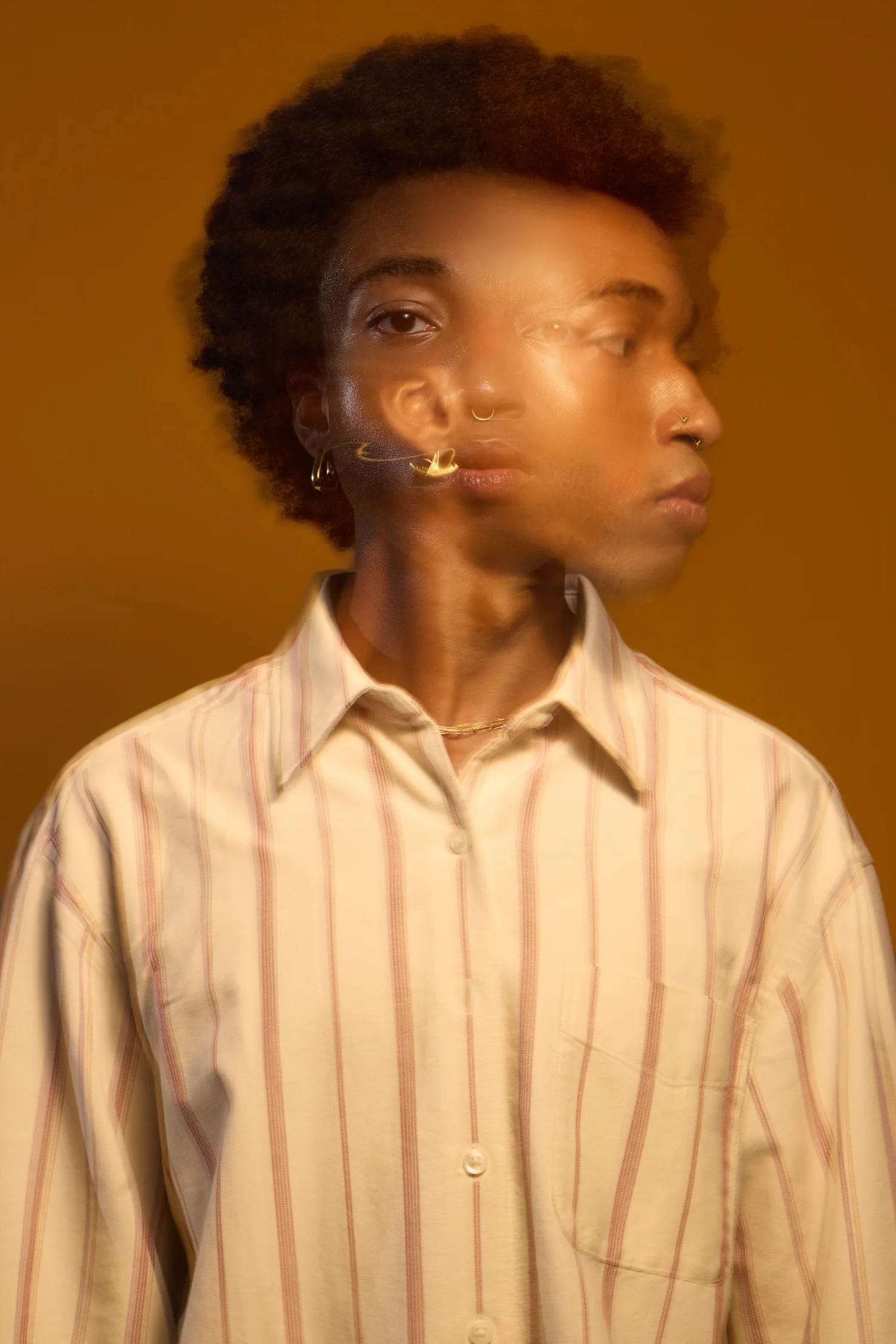
Che Ali (Che Buford) is a violinist and composer from Crown Heights, Brooklyn. Their new album is expected by the end of the year; a recent premiere for solo violin and string orchestra debuted in Lithuania this summer. Find everything at chealimusic.com.