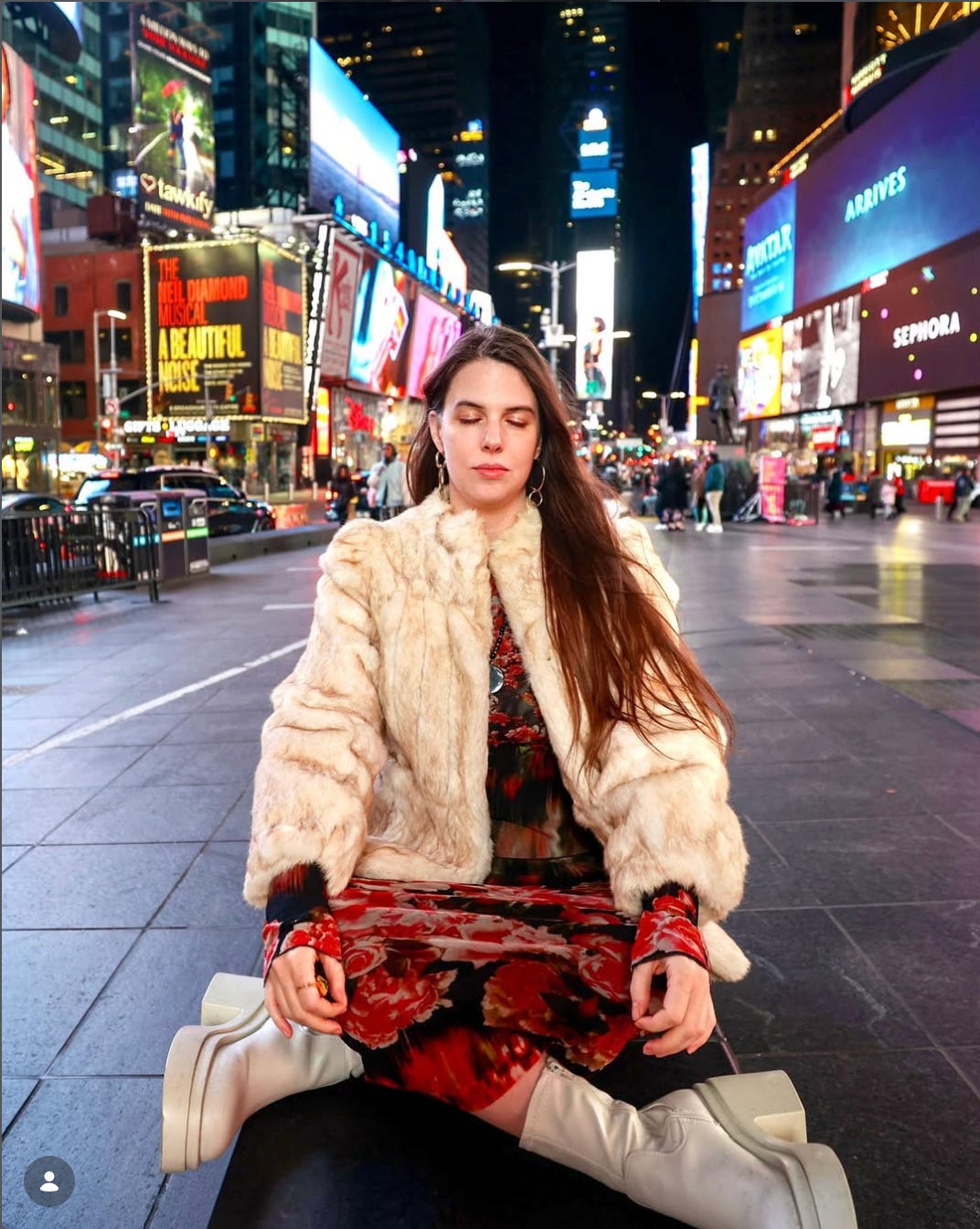
Pritam Siri is a friend and Kundalini yoga teacher who leads a global community in daily practice, now from Puerto Rico. We met in 2018 at a Kundalini school on New York’s Lower East Side, and I’ve been practicing with her and watching her bloom as a teacher and human ever since. We discuss the science of sound currents and mantra, building nervous system strength and leading of the Aquarian age.
This conversation has been edited for length and clarity.
Hope: I was reflecting the other day that I’ve been watching you do your thing for nearly a decade now. I think 2018 is when we met, at our Kundalini yoga school on the Lower East Side.
Pritam Siri: That makes me emotional. I don’t know why, but it does.
Hope: Because so much has happened, and you’ve grown so much! As I was writing the questions I wanted to ask you, I got teary. It’s a reference point for transformation — not just the spirit of it, but the real thing. Not only in the world since 2018, but in our lives, tangled together in these different webs and, individually, as we’ve watched each other grow and bloom. I can’t quite put a narrative arc on it yet. I just know that we met, and then a rocket ship took off, and it’s still flying through the galaxy.
Hope: I’ve been traveling for the last year. I’m currently in Albania for the month. I wanted to give myself an experience of what everyone calls “soft girl life.” In the states there’s a movement to “regulate your nervous system and relax.” But as a New Yorker, I needed backup to even understand what that would feel like, so I set to work giving myself some somatic reference points.
Pritam Siri: Yeah — as somebody who moved to Puerto Rico with the same agenda. We both have a lot of Scorpio in our charts, which just means a little intensity, and only caring about the things that are really sex, death, or transformation. The journey of the soul is, ultimately, every single day, trying to fulfill that desire above the illusion of everything else.
I said, let me have my soft girl era, detox off the New York lifestyle. There’s a huge agenda in the wellness scene that everyone relax and rest. It has merit — we have this capitalism-run-wild situation of more is more is more. But you will not be fulfilled unless you come into an active relationship with the journey of the soul.
We’re not supposed to end this life perfectly manicured, coming out unscathed.
We’re not supposed to end this life perfectly manicured, coming out unscathed — because then you probably didn’t give it everything you had. So I arrived with my soft girl agenda: I don’t want to talk to anyone, I don’t want to be bothered. I’d given my era of service — after years of teaching every day in New York —
Hope: And running a studio by yourself.
Pritam Siri: Right. So I thought, I’m just going to relax. But you can’t really relax if you’re not doing your mission. We can have our soft girl moment where we learn to live in the most exalted state, alert relaxation — and I’m still learning it. Everyone treads that line: can I do better than yesterday, move the ball forward today, and be relaxed and happy while doing it? Some days we need boundaries, rest. But the culture has swung toward apathy. Nothing matters except you vibing out. Everything’s a mess, life’s hard, so just take care of yourself and go take a bubble bath. I’m being dramatic, but —
Hope: No, it’s real. I keep hearing new word couplings forming in my mind to describe our era, and they crack me up. The one on my mind now — I’m assembling it as I say it — is apathetic fascism. There’s this pressure to be different, but different in exactly the same way as everyone else who’s “different.” Be a nonconformist, precisely the way we tell you to. It’s so extreme and so contradictory.
I learned yesterday that the tiny hairs in your ears — the cilia — when they get overstimulated, they just fall flat. They don’t die; they give up and fall over. So past a certain decibel, the sensitive mechanisms your body uses to experience life just lie dormant. I think there’s a version of that happening culturally — whatever is so loud is creating a split: we all oscillate between apathy and the militant enforcement of some pseudo-countercultural politics.
Pritam Siri: It’s this idea that being cool means you don’t care. There was an artist — Oliver Tree — who died two days ago in a helicopter crash, which is sketchy for scorpionic reasons I won’t get into. He used to say everyone wants to be cool, and it’s so exhausting and not interesting anymore. So one side of the apathy is, we’re too cool to engage in caring. The other side, in this soft girl era, is the frequency of complaint and victimhood.
Hope: Ugh, I fall into that, and I hate that I do. I did an exercise in the Gemini full moon workshop you just led, where you had us write down: what are you consciously doing that drains your energy, versus what are you unconsciously doing? The thing that came up for me was complaining about late-stage capitalism. Anytime someone asks, “Hope, why haven’t you built your center yet?” — that’s a big dream of mine, an experimental music school and retreat center — I say, because I can’t afford land. And I’m tired of hearing myself give the same excuse. I’m not necessarily wrong, but I’m bored of that answer now.
Pritam Siri: That speaks to your yogic prowess — your ability to be self-aware without collapsing. Most people can’t even look at that part of themselves. That’s why we do what we call self-psychology teachings: what’s going on in your crazy little mind? You can talk to a therapist or a coach, but the one who’ll be most real with you is the one living in your aura all day.
When I say “agenda,” I mean that when millions of people land on the same wavelength, there’s usually one behind it. If everyone on social media decides the spiritual people are going to be apathetic victims, those people are taken out of the race — they’ve lost all their energy to the complaint-and-victimhood frequency.
What interests me about people complaining about late-stage capitalism — which I don’t think you’re really doing; you’re talking about the pressure of your own situation — is that it’s out of your hands. My teacher tells a story about a woman who was furious about the ending of Obamacare. She complained constantly — to her family, her kids, her husband. She came to him and said, “This is taking all my energy.” He asked, “Do you know Obama? Do you have a relationship with him?” “Well, no.” Something that has nothing to do with you personally, but you’ve been fed a narrative that it should be your main thought — that’s what hijacks your destiny. It’s the news feed of negativity. You focus there instead of, what can I do in my one precious life to bring the world to a better place? So it’s wonderful that you’re aware of what gives you energy and what takes it. Because everyone needs Hope to open her center.
Hope: I need it. Now receiving donations!!
crossing the crisis
Hope: You were talking about this spirit that lives inside. For me, she’s a producer — she has a clipboard, and she’s hyper-aware, constantly scanning all the wacky parts of Hope Littwin. In exercises like that one, she’s the one with the eagle-eye view, the one who hands me the minutes from the internal board meeting.
For me, the hook is almost always money. I didn’t grow up with it. People assume I have money because I’m connected to Princeton as a PhD student, and because I travel — but it’s cheaper to travel the world than to live in New York. So that’s the neurosis on a loop: that costs this much, and I don’t have it. That’s the mantra that runs… Then the producer says, that shouldn’t matter. If you really believe what you say you believe — that energy and consciousness are real, that you can decide it’s different and watch it become different, which I’ve seen happen elsewhere in my life — then why is this one stuck? It’s a crazy Chinese finger trap, because I know it’s bullshit. But this one’s so strong. Why?
Pritam Siri: It’s cool that you can name the part of your mind that watches this. In the yogic science we separate the facets of the mind, and there’s the neutral mind.
Hope: That’s her name. I love that.
Pritam Siri: That producer, who sees the good and the bad and has the vantage point to make good decisions without emotional reactivity. But we all came here to cross the crisis — to burn karma, in Eastern language. People only progress through challenge, and this was the thing handed to you to slay with the sword that cuts through. And it’s familial. When you get over it, you liberate generations to come, just by being the one who says: this scarcity point, I no longer participate in it — and poof, it’s gone.
That’s why wealthy families stay wealthy — an inherent relationship with knowing they’ll be taken care of. So coming from scarcity, it’s harder to overcome later. And yet most wealthy people in the US are self-made — they came from nothing and used that very challenge point, like the best players in sports, the ones who sucked at first and worked twice as hard. They were the runt. That’s your point of power. It looks like the point of pain, and it is, but it’s also the point of power.
The crisis exists to be crossed.
So the teaching is: the crisis exists to be crossed. We have two things in life, the blessing and the challenge — and once you overcome the challenge, it becomes a blessing. So everything is actually a blessing, just disguised. The heaviest things energetically on the planet are money and sex, which is why people use them to manipulate — sex to manipulate, money to confuse, making people feel this is something they can’t be part of, when it’s just energy. In manifestation culture, many would say money is directly tied to self-worth, and that rather than working on the money, you work on a deep reverence and worthiness for having everything you want.
Hope: I actually want to hear that, because I like that style. I don’t want to hear what I want to hear... What’s your point of power?
Pritam Siri: Me too. When someone says, “you’re great, everything’s perfect,” I say, no it’s not, let’s get to the root. For me — transformation and self-expression, fearlessness in creative expression. As you know, I have a lot of creative work I haven’t released. So part of the wound is there: the worthiness and confidence to let it spread the way it’s meant to.
family systems
Hope: That worthiness piece — I feel it in my own body. Where do you think it gets installed?
Pritam Siri: So much of it is the family system. Many of us are living the first seven years of our life on repeat, and that’s not what we came here to do. I love this analogy: you’re born into the family system as an alien. You arrive, and they’re freaked out — who is this in my home? So you put on — this is from the face-reading teachings we’ve studied — a mask of their thought forms, so everyone feels more comfortable. I’m this off-planetary being bringing in new high intelligence, and I don’t want you to kick me out. So I mirror you, and you believe it’s all fine. Most people carry that mask the rest of their lives, instead of peeling back the layers and sharing what they came to share on a soul level.
The other side is that we choose our families. I noticed that my peers in the yoga scene — even ones decades older — all incarnated into hippie parents, which I find hilarious. I needed people eating organic food, sheltering me from really intense media; I’m so sensitive that with total normies it would have been too much. So give me the freak-show parents, that’s fine. And you inherited beautiful musical gifts — no coincidence that you have a musical destiny and were brought into a musical household, so the gifts could be nurtured early. There are major gifts in how we choose to arrive — but any limitations you took on, you can pull off and remove. And you’re very much meant to drop all of them now, so your real mission can begin.
discipline, mentorship, and inner guides
Hope: That dropping is exactly what I want to ask about — because the way I keep trying to get there is through discipline, and I’m still learning how to reframe it for myself. On one side, I want a guide, a blueprint, someone who can say here’s the safest way forward — that’s part of why mantra work appeals to me; these are blueprints that have worked for a long time. But on the other side is the voice you mentioned: only you know. I’ll grab a new orchestration book or teacher, thinking great, they’ll just tell me what to do — and somewhere down the line something in me says, but not like that. And I get so annoyed when I hear that voice, because I know it’s holding me to task.
And that task is loaded, because music isn’t superficial for me. Music saved my life, and my life belongs to it. I was given a spiritual name, as you were — mine is Kirtan Bhakti, which means “devotion through sacred song.” Just another way of saying my life is this path, which means I can’t get away with anything; my soul won’t allow it. Do you have language for holding both — the discipline of a proven path, and the inner voice that refuses to walk it the usual way?
Pritam Siri: We do need to write more, honestly. Let me start here: there’s something you came here to do that no one else can do. My mom’s a shaman, and a friend of hers once said about someone, “His job hasn’t been made yet on the planet. So he has to find something for work until he creates the job that’s going to exist.” You came to do something nobody else can do, because you came to do it.
You’re also what we call Aquarian — helping usher in a new way of being. Which is why, if you follow one mentor exactly and it doesn’t feel perfectly right, it’s because you’re here to do something a little differently than what’s been done before. So your pulse on your own intuition isn’t ego or stubbornness. It’s you noticing, wait — this isn’t quite the thing.
You either have a teacher, or time is your teacher.
The other side is a phrase that helps me enormously: you either have a teacher, or time is your teacher. If you find someone who’s done what you want and you emulate them, get around them however you can, you cut through so much time. I can credit any success I’ve ever had to mentorship. Not that you need to become them — but we need the aura of achievement of people who’ve attained in this incarnation. It’s the blessing of forehead to forehead: this is how I did it, this is how you can.
So it’s important to have both. There’s a phrase: you have always known, you will always know, and you always know. Part of you has that omniscient intuitive power. But to cut through the thickness of life on Earth, we need someone who’s navigated it. For the center you want to build, study how people have raised millions for something like this — who did it well, who didn’t — and follow a similar playbook within your own integrity. Otherwise we lose money and time. It’s one of the most precious relationships I’ve experienced.
“If you have discipline, you don’t need anything else”
Pritam Siri: Then there’s the discipline itself. We just did this exercise of curating our own affirmations: write down eleven points of challenge in your life — the most frustrating, very specific things. Then write the counterpoint, eleven affirmations: I am successfully doing this, whatever’s the opposite. Why am I telling you this? Because when I wrote my eleven challenges, it hurt — I realized every single one could be solved with discipline. And one of my teachers, the most disciplined person I know, Gurujas, said so casually, “If you have discipline, you don’t need anything else.”
Discipline of the mind — are you watching your thoughts or letting them run wild? Discipline of your time, of your actions. And this is so far from the soft girl core. People say, “you’re such a soft, nice little teacher,” and meanwhile only discipline is getting anything done. That’s my challenge point — refining discipline even further.
The freedom is in the structure.
We want to be free spirits, and we don’t realize the freedom is in the structure. The creativity, the flow, is in the structure.
It hurts to hear, but think of it this way. I think it was The Police — it might not have been. They had an album due fast, went to a studio with about ten days, and wrote their best-selling album start to finish. That’s structure. They’d never have finished without a deadline and a locked studio door. There’s a beautiful Buddhist phrase: practice like your hair is on fire. The challenge is to live with that intensity and urgency and be relaxed at the same time.
We have so many examples of people, especially women, who burned out because they went too hard into the masculine go-go-go. There’s a way to get a lot done and also rest as needed. I think we can look to European culture for that, since in America we’ve gotten confused about what balance means.
Hope: That’s a big part of my traveling — experiencing concepts when they’re baked into a culture. Here, people will spend two hours over a coffee without rushing, and still get things done. It’s a different relationship to time, and to values, because relationships matter as much as work. It’s giving me a new reference point for nervous-system awareness, so I can feel in my body what it’s like to work in a relaxed, relational state — instead of my old pattern, where I serve a crowd of people and then shut down and isolate to recover. I’m in the practice of experiencing alternatives.
Pritam Siri: We may spend our whole lives looking for that balance point, honestly. Which I’m fine with, as long as I’m progressing.
sound missions
Hope: How do you track your progress?
Pritam Siri: By a feeling, and by accomplishments. I have goals, and I want to meet them. But the real importance is enjoying the process, because life isn’t just a set of goals to reach. It’s enjoying what we call the maya, the illusion — your coffee, your friends, a slice of pizza, going dancing. And know that none of it is essentially real, and that you have a job on a soul level: to progress what you came here to do. So we hold it lightly, get a lot done, and then appreciate how beautiful the world is.
Hope: How do you see your mission?
Pritam Siri: My mission has to do with sound. Leaving a certain sound on the planet — whether in the written word, in song, in lectures, however it manifests. That’s what I’m uncovering. Lately I’ve taken comfort in how the Buddhist masters lived, because I don’t find many examples of how I want to live in the modern world. Many of them opened monasteries, wrote dozens of books, led thousands of students — all in one lifetime. And they weren’t worried, “if I release my book of poetry, will it confuse people?” It was just a constant flow of creativity. Because the more you have a spiritual practice, the more creativity you have. That’s the creative life I want to live more deeply in the coming years.
Hope: Me too. Say more about the science of sound, because this is a part of Kundalini that other traditions don’t emphasize, or don’t talk about as much. As a human, it seems obvious that sound has an enormous impact and is the basis of all life. Everything is vibrating — that’s basically your whole experience of the world, and it’s all sound. But Kundalini has a beautiful way of talking about it.
Pritam Siri: It feels silly to explain this to you, since you’re the expert.
Hope: I’m not an expert. I’m endlessly curious and endlessly mystified. One moment it seems self-evident — everything’s vibrating, of course the world is sound, string theory is foundational. The next minute I’m dumbstruck by the exact same revelation. Everything is sound! K.O.
Pritam Siri: It’s awe-inspiring. If everything went silent right now, the world would disintegrate or explode. Everything is vibrating, inanimate objects included, and so are we. We have aura, electromagnetic fields running on this frequency of sound. The human aura is usually six to nine feet out. Animals are more like three to four.
Hope: That’s so big!
Pritam Siri: And everything operates at a certain frequency, a certain speed of sound. The input that really —
Hope: And you can change it, right? You can change your own field, your own vibration.
Pritam Siri: The input that most changes your frequency is the thoughts in the mind. The biggest understanding is that you are what you project. So you are not you; you are what you project, and everyone responds to that projection. Which is why there’s no correlation between intelligence and success. There are brilliant people with a poor self-concept, and it weakens the aura. No matter how great they are, if they don’t feel themselves to be great, others can’t acknowledge it. And all of this is the sound of how you relate to yourself.
I work a lot with that axis of self-worth, because I know so many incredible beings — creatives, artists, parents — who haven’t gifted themselves the grace of self-kindness. They haven’t crowned themselves, haven’t decided they’re amazing, so the world is harder for them. Meanwhile you see people popping off who are no more special than you — they’ve just decided they’re worthy of it. So it’s vital to use the power of self-talk to build a new relationship with sound.
We have two ways to accelerate this in the Kundalini system. First, native-tongue affirmations — talking to yourself in English, deciding you’ll respect yourself differently. Second, the mantra: a permutation-combination of very old sounds. Many are off-planetary, channeled — some thousands of years old. They’re time-tested, passed down for generations. The sounds we use most are in a script called Gurmukhi — similar to Sanskrit, just a little newer.
The idea is that their arrival here was almost an accident, an “oops,” because Earth is considered a place of degeneracy — I love that word, it’s very Gen Z, and it’s also in the yogic scriptures. The ruling powers here have made it a place of fear and destruction for a long time, and it’s unusual for sounds of this caliber to enter. So we have these paragraphs you can chant or recite, and they turn you from the fate current to the destiny current. The Mool Mantra, the one you know — it takes you from “life is just happening to me and there’s nothing I can do” to “I can create whatever I want, and I’m riding the current of life rather than it riding me.” It’s life-changing.
back in the river
Hope: This is very real. I have to confess something: when I meet a new practice, I give it the benefit of the doubt first — what do I know, but whatever I’m doing isn’t working, so let me try what’s working for these people. I remember the Mool Mantra specifically, because I played it under my pillow at night for nearly a year. That was maybe ten years ago, and I was in such a state of desperation that it felt binary: either I’d combust from all the psychological pressure I was under, or something like a breakthrough would happen and I’d go into warp speed and end up in a new galaxy. I couldn’t logically imagine myself out of the state I was in. That sound current felt good — like a safety bubble around my energy. I felt held and protected by that mantra at a time when I felt very unprotected. It’s still something I come back to.
Sound currents that carve a new path are so necessary, because we’re not fresh beings with no context; we’re born into the deep groove of our culture and our lineage, and to shift that even slightly takes immense effort. The crisis points along the way almost multiply the battles, because the negative current, ironically, runs so much more smoothly. Everyone in the family system is comfortable with it. Then one person alters the current, and they’re the troublemaker. That would be me… But I’d never go back. It’s humbling to learn what it means to follow a new current — which isn’t floating safely down a new river. At least for me, it’s been a different process entirely.
Pritam Siri: In the sixties, when people started using the word “vibe” — it really is a vibe. The lower vibrations are doubt, fear, scarcity, victimhood, guilt. Then you climb into love and acceptance. Really there are only two currents: love and fear. The higher you climb into love, the more your frequency literally rises, like a thermometer. You become more magnetic, a resource to yourself and others in a whole new way. So when you chant the mantra, it’s raising your frequency. And then you become a beacon, showing others what’s possible without a word. You pass someone on the street and they feel the brush of a person who loves and accepts themselves, and they get a momentary transmission: it’s possible for me to feel this good. That’s the power of mentorship — a deeper version of that, being around someone who has what you want.
Hope: And that current can’t be rushed — which is the other thing humbling me right now. I’m in my “things that can’t be rushed” phase of life, and recently a newly initiated gym bro. The newest phase of my spiritual enlightenment: my gym bro era.
Pritam Siri: I saw a picture and had to triple-take. Is that Hope? All spandex, lots of muscles, super hot.
Hope: It’s my new vibe — just me and about twenty-five beefy Balkan men in the gym in the middle of the day. I mostly keep my eyes on my own biceps, but they do wander from time to time… It’s been a great way to visualize my spiritual life, because of a sneaky thing about me: I always think I can rush things. Like I can find a faster way, or 10x this. I’m clever, I’ll outwit and outrun it. Sometimes that’s cool and can lead to innovation; other times it really holds me back. The gym is great practice, because you can’t build muscle faster than you can build muscle. It’s a 48-hour window of tear and repair, and no one can rush it. You can make progress, but you can’t 10x a bodily process that won’t be 10x’d. So that part of me that likes to hack systems gets addressed daily.
magic and muggle
Pritam Siri: I suggest combining the best of both — the earthly and the magical. This is why a vision board alone doesn’t work. Just thinking about what you want doesn’t work. So if you want to create the music center, pretend you have no magical abilities at all — which is hard, because Hope is very magical. What would you do? You’d get technical, business-minded, analytical, organized. You’d map it all out and run every earthly-realm best practice.
Do that, and then — even five minutes a day — spend a little time in the spiritual realm, and it will change your relationship with progress and time. Beam the mantra onto whatever you’re building; even a three-minute timer on the project starts to morph it. Then spend thirty minutes to an hour a day on the actual infrastructure. Next thing you know, so much moves — because you’ve added the discipline of relating to both every day, the gross physical and the energetic. That’s where a lot of people just don’t. They say, I’ll vibe out and it’ll come when it comes. But it might not.
I’m teasing us, but I see it constantly: have you done the most obvious thing? People who want a relationship say, “I’ve chanted all the mantras,” and I ask, have you gone on a date? Are you on the apps? Have you put in the reps? Sometimes it’s a plainly physical next task. But when you add the magical part — projection, intention, prayer, these sound codes — things move much faster. I’ve seen it with successful people who have a practice: how did they manifest all that? Because they did what they’re supposed to do in the earthly realm, and then added the high-frequency energy that removes the blocks.
nervous system and sustaining voltage
Hope: How do you handle the speed? Guru Jagat used to talk about this — no one talks about the energy it takes to sustain success. We talk about the energy to reach a peak for a moment: I played that arena, that stage. And then so much voltage is running through your body that — many times, for me — zzzz, you short-circuit and collapse. And the energy to get back up again — it’s like getting bitten by a dog, and then having to keep walking past the kennel, telling yourself, okay, it wasn’t as scary before. I can feel when something’s right, when it clicks, a current running. But that doesn’t mean I can sustain it as long as I want to. There’s an awkward learning-to-ride-a-bike-and-keep-falling thing still happening here.
Pritam Siri: What you’re describing is nervous-system strength. We’ll always have that warble of reaching new heights. But this is why we don’t just chant the mantra. In this Kundalini system we have mantra, then breath work, then movement, or kriya yoga. It’s a complete science, and it doesn’t really work without all three. I mean, you can chant a mantra alone and change your life. There’s a story of a very unhealthy woman who chanted a long shabad every day. She went to the doctor, who asked what she did. “No physical activity, I just work behind a desk.” “Yeah, but what are you doing?” “Well, I chant this mantra.” He said, “You should be dead. By all parameters, you should not be alive.” The sound current kept her alive. But we want more for you than staying alive. We want the nervous-system strength to do what you came to do, and enough prana, enough breath, to do it.
That’s why we have the trinity: mantra, breath, movement. The nervous-system overhaul in our daily session, I hope, is giving you the strength to reach your next level and hold it. But I also encourage conscious reprogramming. There’s a reel I saw of a man terrified of public speaking who did seven minutes a day of “I’m a great public speaker.” Fourteen days in, it was done. It feels obnoxious, but Michael Jackson did it, and plenty of others.
What you want must be re-ingrained constantly, along with your worthiness to hold it. The mantra cleans the subconscious and directs us to a higher frequency; the breath work gives us enough energy to hold it; and then we build the nervous-system stamina to enjoy it. I like to take a challenging kriya and say: this is for my project, for my destiny, for my self-worth, for the relationship I’m calling in. It helps you realize you’re building not just physical strength, but a whole energetic structure, perfectly tuned to receive whatever you want.
It makes me sad that so many brilliant people don’t have the nerves to simply enjoy their lives more — or to receive more recognition or wealth — because their nervous system is shallow. It’s common right now, given the onslaught of information and pressure on the planet. So nothing’s wrong with you. But if you find yourself easily stressed, overthinking, unable to relax, the nerves may be a little wrung out — and there are plenty of practices to grow from there.
Hope: It also becomes a cultural expectation, a weird trade economy. After a recent month-long tantra yoga training in India, the shock of coming back was how unnecessarily stressed everyone is. This is a strange language we all speak and trade like currency, and it helps no one. And it’s not a flex. “I’m more stressed than you” — what? Are these the coins we want to trade in our community?
Pritam Siri: That’s a great observation, and you should write an article about it and shout it from the rooftops. Then find companions you can talk to about how good you are, how things are going, your growth and creativity — without them dragging in, “but are you stressed, is anything going wrong, did you hear what she said?” Because that’s a lower frequency. Stress has become a badge of honor, which is hilarious. I’m all about finding new friends and communities now who meet you on the higher aspects of your life — not the ones addicted to what we call the stress personality.
gossip and outgrowing your tribe
Hope: And how do you work with gossip? This has hit me hard the last few years. For a while I put all my energy into accessing a certain current — not just productivity, but a life I wanted, projects I wanted to finish. I didn’t know how it would happen, but I kept seeing this image of a fast-moving river, a strong current where if I stepped in, it was a real commitment to a flow state. Anytime I washed up on shore, I’d tell myself, Hope, get back in the river.
But a side effect was that, being socially absent from the surrounding culture, stories about me started circulating that were genuinely hurtful and damaging. And because I was elsewhere, I wasn’t paying attention. When I reached a natural end — okay, I want to reconnect with what’s around me — it was a shit show. Rumors had spread, and I no longer felt welcome in places I’d thought were my crew. Is this outgrowing certain communities? Or did I stop building relationships, so people got confused about who I am and started telling stories? I’m sure you’ve been misinterpreted — and when it hits harder than “that’s a silly story,” when it’s “ow, that actually damaged my reputation, and now I’m pissed.”
Pritam Siri: It’s probably a bit of both. Maybe you weren’t reaching out, and people felt you weren’t there for them. And also, you’ve probably outgrown it — it’s a frequency thing. People keep dropping out of your life as your frequency rises. In creative scenes especially, it’s hard to find groups truly connected on making things happen — not being creative and complaining, creative and playing victim, creative and judging everyone. I saw an artist say, “What do you mean, don’t judge people’s art? Every artist is an asshole, that’s what we do.” Which is funny, but it’s rare to find people who are actually making things happen. So you may simply be outgrowing people on a less creative wavelength. And that’s what you want.
Unfortunately, one of our primal fears is being ostracized from the tribe. So it’s genuinely scary. I’m sorry you went through that. It sucks.
Hope: Many times, though — which is good to note, because I forget. Each time, I think the world is going to end. And then it’s like, wait, the world has ended many times already. So maybe.
We have to hold semi-delusional thoughts to create the new world we want.
Pritam Siri: Yeah. One of my teachers has a phrase I hold close: the universe is conspiring in my favor. We have to hold semi-delusional thoughts to create the new world we want. So you lose a friend — the universe is conspiring in my favor. Even if it seems negative now, surely there’s wisdom here I can’t yet see, and I’ll move forward knowing it’s placed me in a new frequency I needed. When I started seeing everything through that lens, I took back a ton of energy I’d been losing to emotional reactions. Something negative would happen, and immediately — wait, how is this a gift? The tire went flat because we’re being protected from something. We have to trust the orchestration beyond our understanding. My prayer for all of us in creative worlds is that we build new communities in a higher frequency, just making things happen.
leaders and stars
Hope: That’s the key. And this is what music does when it’s really doing the thing. It holds space for a different current to run. There are concerts where it’s happening — it switches on, and suddenly the task is happening, they’re doing the thing, this is what I know music can do. It comes down to incredible leadership. I have a teacher who says she’s always looking for the access point where people feel invited to participate and responsible to the group. Everyone shows up as fully as they’re comfortable, and everyone feels responsible to the whole. In that space, magic pours out. But it’s rare. I think it’s because we’re raised to be stars — you have to be the star. And that needs redefining. A true star is a great leader, someone who draws other people to show up more fully, to bring out more of what’s in them.
If you have the seed to plant that, it’s infinitely regeneratable. But “be the star in the room at all times” is lazily defined, to the detriment of many rooms. In the spirit of collaboration, which is my obsession — even my solo work is collaboration. Coltrane used to say, when he was soloing, his eyes were on God; that’s who he was thinking about. So it’s a dialogue with a bigger aspect, not a man talking to himself about himself in a context of only himself.
Pritam Siri: Beautiful. I love that.
Hope: Creating great leaders — I think that’s part of your mission too.
Pritam Siri: Yes. The Kundalini system isn’t designed to create more students; it’s designed to create more leaders and teachers. The prophecy is that this will be needed like water at this time on the planet. People desperately need a drink of something that nurtures them in a new way, and we need as many people as possible sharing it. Here’s how to breathe consciously, here’s a sound I’m using to change my life, here’s a three-minute practice that resets me — no external stimuli, nothing added. People are doing wild things just to survive on this planet, and for thousands of years we’ve had these immense tools that let people thrive without extreme measures. I think of them as ancient-future teachings: ancient, but deeply futuristic and essential for a good future on the planet. They transcend religion and region; they’re just meant to make you more you. A leader is someone who can reach that third position — the neutral mind — and see everything as it is, objectively, in service of the greater good.
Hope: I’m curious for you to tell your story, in your own words — how this technology transformed you, where you were when you found it. A lot of people find Kundalini when they’re in crisis, because it’s so… weird. To this day I think, if anyone saw me doing one of these kriyas out of context, they’d send me to the loony bin. I still remember one of my first classes at Rama, when one of the first things we did was bend over and scream through our legs. We’re all facing the street on the Lower East Side, people walking by, and we’re just screaming through our legs. I thought, okay, I’m here. This is where I am.
Pritam Siri: That’s so funny — I don’t know that screaming one. Some of it isn’t that weird, but it can get weird. I saw a guy doing a different kind of kriya on the beach the other day and thought, what a freak, what is he doing? Then I realized he was doing a kriya, and thought, my God, here I am judging him for something milder than what I do.
But where it found me. I was living in Nashville, doing a lot of hot yoga and kickboxing. And I kept thinking, isn’t yoga supposed to be spiritual? So I Googled “spiritual yoga” and found the Kundalini center. I showed up cocky — I was fit, so I figured this’ll be easy, a room of older and middle-aged women. It kicked my ass, because it’s a nervous-system thing; a professional athlete will come to class and not be able to hold the posture. So I’m thinking, this is so hard — and I look over and all these women are doing it fine. Then I had a spontaneous heart opening, just laughing in a posture. I was chronically depressed at the time, so I thought, this is weird. And the teacher said, “Yeah, you had a heart opening.”
It was still too weird for me, so thankfully I found a teacher who made it accessible, Guru Jagat. She made it feel normal — she was a normal person — and brought in thousands of new students by being human while sharing the teachings. I studied with her and devoted years to it, and that’s how I got everything I’ve gotten.
One thing I did at the very start was eleven minutes of Breath of Fire every day — equal inhale and exhale through the nose, just sniffing in the air and letting the exhale happen. I was working two restaurant shifts, saving up to move across the country and work for my spiritual teacher. I’d do the eleven minutes in my car between shifts, and I still remember how wild it was. I’d go from cranky and tired, needing caffeine, to a high, exalted realm — then walk into the next restaurant a totally new being. The breath adds energy, which adds opportunity, which adds wealth. My income started rising, and I got the resources to live out my dreams in California. I broke through the glass ceiling every time I gained more energy through the practice. It was crazy how fast things changed.
Hope: There it is. That could be yours too, people. Run the energy current.
Pritam Siri: You too. It’s free. You want to get high, feel good, look radiant and beautiful — breathe. Check it out.
where to find Pritam Siri
Hope: I love it. Do you want to tell people how to connect with your work, your teaching, your sounds?
Pritam Siri: For free, I have a YouTube channel — Pritam Siri — with a lot of classes, and we do a live session every Sunday at 9 AM Eastern, practicing together. We love to talk and philosophize, but ultimately you’ve got to get wet. Jump in, see what these weirdos are talking about, try it yourself. We’re not asking you to take anything out of your life — you just add a little of this in, and you’ll watch the structure of your reality transform. Find me on YouTube and Instagram. I offer deeper workshops and memberships too, but just start there, and reach out with any questions.
Hope: Thank you so much for leading every morning — the great reawakening. It’s amazing that I’ve known you this long and gotten to watch you bloom and bloom and bloom. I’m so proud of you.
Pritam Siri: Thank you. I’m so proud of you too. You’re such an incredible creative being, Hope, and I can’t wait to see what else unfolds through you. It’s subtle, but what you have to give is very different, in that subtle way. Continuing to share your creativity without apology and without repression is genuinely medicinal to all of us. So thank you.
Hope: Thank you, Pritam Siri. I’ll see you tomorrow morning, 3:30 AM EST.
Pritam Siri: Badass, honestly. We don’t usually talk about it, but since you mention it — it’s happening, if anyone wants to join. Hours of yoga in the middle of the night. And it’s worth it.
Hope: And why 3:30?
Pritam Siri: If you’re lucky, like you — you’re in Europe, so you can do it later in your day. Because practicing before sunrise is much more powerful. You’ll find this across spiritual traditions, but in this lineage it’s forty times more powerful, and it has to do with the angle of the sun to the earth. The subconscious mind is unloading heavily, and you can clear out so much. So we’re in it to win it.
Hope: Hell yeah. Hardcore. I love it. Thank you so much. Love and appreciate you.
Pritam Siri: Love and appreciate you. Sat nam.