HOPE: Where are you?
EMANUELLE: I’m in Jerusalem, in a neighborhood called Abu Tor.
HOPE: I’m curious about the shape of your days. To catch us up a little: you graduated last May and went almost immediately to work. Is that right?
EMANUELLE: I had a couple of months, and in August I came to Jerusalem to start a fellowship, doing anti-occupation and solidarity work. Now, I’m working for an organization called Achvat Amim, which translates to Solidarity of Nations. We exist to be both a learning and an organizing engine here. I’m a field coordinator and well-being counselor for a summer cohort of twelve people. Some of them are here for the first time ever, and some are here for the first time in this way; maybe they’ve been to Israel before, maybe they’ve even been to settlements before, but they haven’t been to West Bank Palestinian communities to do solidarity work. We’re introducing them to the landscape of human rights and anti-occupation work here. Specifically, I’m coordinating partnerships with two villages in the South Hebron Hills, in a region called Masafer Yatta. One of them is called Tuwani, the village where No Other Land was conceived and filmed. The other village, nearby, is called Umm al-Khair. So I’m in the field in the West Bank with the cohort two days a week, and I also do processing, programming, and field work preparation with them back in Jerusalem.
HOPE: We met in a class at Princeton during your senior year, and everything I learned about you then had to do with community. I told you about my dream of building a community center in the style of Black Mountain College, and you told me about your own history with those kinds of spaces, much of it rooted in your religious and spiritual upbringing. Do you want to start there?
EMANUELLE: My dad’s a rabbi, my mom’s a professor, I moved around a lot. I was born in California and grew up mostly in Minneapolis, and then in Lexington, Kentucky. In Talmudic law there’s a literal string that’s put up on trees and telephone poles, called an eruv, and it designates an area where traditionally observant Jews can physically carry things on Shabbat and holidays. And my parents were sort of obsessed with the fact that in one of our houses in Minneapolis, the front of the house was inside the eruv and the back of the house wasn’t. It became a metaphor for them, and then for me: I had one foot and one big part of myself in the Jewish world, a world that cared about these Talmudic fictions, and I also had a foot and a self and a community in the broader world. My life was about straddling those commitments. On one side was what my parents saw, and what I came to see, as the power and beauty of Jewish song, tradition, ritual, teaching, and text. On the other side were its limitations.
I grew up very comfortable in shul. I spent tons of time in synagogues as a kid, and it isn’t limited to one particular place. Shul is less a physical place than a familiarity with the songs, the ritual garb, the metronome of a service, and the service being both the liturgical one and the eating and chatting and sharing space in all the other ways. But I was also really comfortable in spaces of protest and political organizing. I was being brought to protests and political actions before I can even remember.
At first I didn’t see myself as political. When my family moved to Lexington, I started to understand why my parents identified in the ways they did and what all of this was about. It went from being the water I was swimming in to being my whole orientation. I joined a group called the Kentucky Student Voice Team, not because I knew I was interested in political organizing but because they were the coolest people I was meeting. Then I grew to really love organizing. That work in Kentucky brought me into a landscape of progressive youth organizing around the country, and I started doing cross-issue work. A little of it had to do with Israel-Palestine, as a left-wing Jew, but honestly that was not the center for me at all.
When I got to Princeton, there was a group that had been around since 2014 called the Alliance of Jewish Progressives. I got to campus in the fall of 2021, in the aftermath of COVID, and the group was in a moment of figuring out whether it was going to exist. I remember sitting on Poe Field with people who had just taken mid-college gap years, saying, well, let’s try to exist again. We had some nice Shabbat dinners. It was a sweet community. But as things ramped up around this issue, on campus and globally, AJP became a very central group, even before October 7. I started leading it my sophomore year, when the seniors passed it on to us. That year we had one of the first controversies of my time on campus: Mohammed El-Kurd was invited to speak, and it was a major controversy.
It’s about sitting with people in their suffering and meeting them there.
HOPE: I was there.
EMANUELLE: We were the only Jewish group on campus defending his right to speak. Our position was that we don’t have to agree with everything he says to believe in academic freedom. You might remember that other Jews, including the Chabad rabbi, were interrupting the talk, shouting things like, “you’re an antisemite.” That began a pattern of us fighting with the University and with other Jewish institutions on campus. A few months later a professor came under fire for planning to teach Dr. Jasbir Puar’s book The Right to Maim. We again defended her academic freedom and were really involved in that campaign. And not long after that, October 7 happened.
As Jews on campus with left-wing commitments, we found ourselves alienated from the Jewish community that was mourning in ways that called for vengeance and celebrated an ethno-nation-state we knew to be violent, and knew was only going to further entrench violent realities. We organized vigils, we talked to our Muslim and Palestinian peers, we pushed the Jewish community, we created alternative spaces. And it quickly became clear that the analysis was not what had been thrown into crisis. Israel and the global order behaved as we feared, and the onslaught in Gaza worsened dramatically. That colored my college years. Some of my most powerful and hardest moments on campus had to do with navigating a landscape dominated by Israel-Palestine even so far away from it: die-ins, vigils, a focus on what was happening in Rafah, all of this before the spring 2024 encampments. By the time those came around, it was very important to me and my peers in AJP to be involved in a lineage of anti-war student organizing that extends far back, which we had learned about and been inspired by.
That became the center of these formative years no matter what else I tried to do. I studied literature and art; I was in the English department with a minor in creative writing and history. I didn’t study the Middle East. I didn’t learn these languages. As much as I tried to run away from it, these were the things that pulled me back. And as I thought about what I saw myself doing after graduating, I kept returning to the idea of being on the ground here in Israel-Palestine, learning directly from Israelis and Palestinians and working with them. I knew quite a bit about the landscape, but I had only been here once, for two weeks in 2019. So when I came in August it was a total throwing myself in, semi-blind, and the year has been about uncovering layers and layers of the reality.
I didn’t need to come here to recognize it as genocide or ethnic cleansing, but it is different to witness settler violence up close. It is different to have relationships with Palestinians on the front lines of ethnic cleansing, to watch land taken over in real time, to have the little bit of Arabic that I do, to hear these languages all the time. It changes things, but the changes are subtle. It’s not my political analysis that has shifted.
HOPE: I’m curious about your parents, about what was instilled in you by watching them live. Having a rabbi for a father must have meant seeing conflict mediated in community very early: two people are disagreeing, so how do you hold court for a disagreement? And a mother who is a professor comes with her own set of skills. Those are the raw ingredients. Then it’s time to cook, and then there’s the sweat of the line cook getting orders out fast, which is another thing entirely. Looking back, can you see where the proclivity and the skill set came from?
EMANUELLE: Being the daughter of a rabbi meant sitting at meals and in conversations where I was uncomfortable, with the expectation that I move through the discomfort. That is the work of being in community. Before we get to any grand political anything, there are personality clashes, there are the challenges of sharing space, and there is a sort of intimacy in that. I heard my dad speak all the time, and I think he taught me how to speak. My mom taught me how to write. I watched them host: people really close to us, and practical strangers, and I learned from that.
When I think about the work I’ve been doing this year, I’ve been frustrated at times, or confused. It’s been destabilizing to go from the clarity of who I was in the ivory tower of Princeton, and I don’t mean only in the icky institutional way, but in the way of really wonderful relationships built over years, mentors and friends and professors, a clarity about what the space was and who I was in it, my role in regard to AJP, my role as a student, my role as a friend, to a space of far more humility. To be relatively a stranger here. To say: I am not of this place. I am not Palestinian. I am not Israeli. I do not really have these languages. And to do the work: to clean kitchens and hold babies and wash floors, and to have that be the political work. The work in the U.S. was most often rhetorical. We did a lot of reading and arguing and fighting and speeches and press releases, and it’s not that such work doesn’t have meaning, but the work here, at least the work I’ve been doing, is not about that. It’s about sitting with people in their suffering and meeting them there. My parents absolutely modeled that for me, in subtle ways and in more frontal ways. There have been times when I’ve missed the clarity, or the arrogance, or the intellect of life before this, and I struggled to articulate it, and a friend who really understood said, “you’ve been using your heart, not your brain.”
As much as my parents are intellectuals who modeled the brainy stuff, I think watching my dad do the work of pastoral care taught me the most about how to navigate what I’ve been doing here. It’s not the frontal part of the job, not the sermons or the services or the life-cycle rituals. I knew he was on the phone with a congregant, visiting somebody in the hospital, speaking with people who had just lost a loved one, counseling a couple, supporting people through major transitions.
I’ve become really close with a woman named Hanady Hathaleen. Her husband was murdered a year ago. Their family was internally displaced during the Nakba in 1948 to Umm al-Khair, a village in the South Hebron Hills, and they have three little kids. Awdah was an activist and a teacher in the community, who built relationships with organizations and leaders across the world. He was beloved beyond beloved. On July 28 last year he was shot while peacefully filming a settler and his entourage. The settler’s name is Yinon Levi. He was sanctioned under the Biden administration; he is not sanctioned under the current American government; and he had before this, and still has, a very well-documented pattern of violence. He shot and killed Awdah. I’ve spent countless days in Umm al-Khair getting to know this village in the immediate aftermath of that acute loss. It will never make sense that I get to hold Awdah’s kids and he doesn’t get to hold them. It will never make sense that Yinon Levi walks free and Awdah is dead. So what does it mean for me to sit with Hanady, and to hold their babies? It’s not flashy work or brainy work, but I think it’s important work, and I feel very privileged to be in relationship with communities and families like this one.
HOPE: There’s so much I want to pull on there, but one pattern is emerging. The ivory tower also represents the distance the United States keeps, the intellectualization that makes impossibly huge and charged subjects feel approachable. If we can retreat into the comfort of our minds, we can engage. That word, charge, keeps surfacing for me. And as you say, living from the heart is not encouraged in this culture, least of all in our educational institutions. What goes missing is experience. I was just reading a book by a scientist I admire, Marcelo Gleiser, a deeply spiritual Jewish scientist, who argues that the blind spot of science is personal experience. We forget that the only way we receive information is through the body: the temperature drops, and we feel the temperature drop. We’ve been strangely numbed to that as a method of living.
So let me ask… what do you think people are craving? When you’re doing any kind of leadership in community spaces, and by leadership I also mean simply showing up to be with families, seeing a need and meeting it in a way that actually helps, you learn that what counts as helpful shifts constantly with the circumstance. We are trained, especially in the West, to intellectualize: to read, to write, to give speeches, to become great orators, to understand a landscape well enough to argue for it or against it. Stepping into something heart-centered and physically immediate, like holding babies, can feel almost like a silly game by comparison. It’s a space that isn’t so much discouraged as unrecorded. We don’t measure what we don’t value, so all of that information goes uncounted, and it never reaches the places we’re told to go when we really want to know something.
I relate very much to the tension of being inside a structure you excel at. Its bookends are simple, clean, and polite. It’s like walking into a minimalist house: one couch, one table, and I can track everything happening in the room. The measures of success are legible. Here is the blueprint, here is a closed system of logic, here are the rules; you play, you win or you lose, you get another turn. Stepping out of that is stepping into a different ecosystem entirely. I often think about the word courage coming from the word for heart. Can you practice courage if it’s only intellectual courage? Courage belongs to a different organ. And it’s terrifying, because we’re built for win-lose propositions, for a realm of knowability that feels comfortable. I guide a lot of improvisation circles, and I’m used to people panicking: I need to know exactly what’s going to happen before I show up. That conversation has become routine for me, and in a very different register from yours, I see the same fear. What are the rules here? The answer is that you’re stepping into a new universe. There are things I can prepare you for, and there are things that require you to expand your capacity for not knowing. It isn’t about becoming more clear. It’s about becoming more brave.
That threshold is not something I, or any guide, can cross for a person. Each of us has to meet it alone and decide: even though I don’t feel entirely safe, I’m going to take one step closer. Then it’s the guide’s job to know where their responsibility actually ends, which is a constant tension in my life. What I can say is that my experiences in that heart-centered domain ground me like nothing else. In intellectual spaces I’m easily knocked off kilter, easily made to feel insecure, easily left wondering whether I got it right. The experiences that live in my body, many of them through nature, are the ones nobody can make me doubt. People try, with some offhanded comment, and being a woman in any position of leadership means being undermined in slight ways constantly. But those lived, visceral experiences roll straight off my back. That part of my system can’t be penetrated, because it was built in a way you don’t have access to.
You’ve been using your heart, not your brain.
EMANUELLE: I resonate with so much of that. The conversation you describe, bringing people into a space of unknown, whether in musical improvisation or something else, is the conversation my mentors had with me when I arrived here and the one I now have with the people I’m bringing into this work. It’s about becoming comfortable with a very high degree of unknowns, of lack of control, of inability to plan. That doesn’t make any of it okay; I don’t want to fetishize conditions of oppression and apartheid and settler and state violence. But that work, especially for those of us not coming from this context, is such a big part of it. My final project for the fellowship was a chapbook. I called it The Place I Return because so much of what I was experiencing was the back and forth between Jerusalem and Masafer Yatta: going from contexts of relative assurance, privilege, and security to contexts of unpredictability and volatility. Not that there isn’t a lot of love there too. But that back and forth is the whole thing. And learning, as you say, what I can give and what I can’t, what my limitations are, that I can’t be there all the time, that I need to do the back and forth even though the coming and the going are some of the hardest parts.
HOPE: Why is it hard? What makes it hard?
EMANUELLE: First of all, the communities we’re in want us there so badly. There’s actually been a departure from the language of “protective presence” toward simply “presence,” or “solidarity presence” because having internationals present is not really decreasing the rates or intensity of the violence; that theory has unfortunately been debunked. And yet the communities I’m in relationship to, and it’s not true of every West Bank Palestinian community, but it is true of these, really want people there, and they’ll say it to anyone who comes. Every time you leave, you’re being asked: “When are you coming back?” “Can you stay?” “Can you sleep here tonight?” In quite forceful language, with a grandmotherly love: “No, stay.” So every time you leave, you’re letting them down to some degree. And secondly, every time you leave, you’re traversing radically different contexts. I have my clean apartment and hot shower. I can make myself whatever food I want. I have tap water that’s safe to drink. I can go out to a well-stocked grocery store or a restaurant, meet up with friends. I have freedom of movement. Even the journey itself is something West Bank Palestinians can’t do, and in the rare cases where they can, they have to pass through checkpoints and other mechanisms of state oppression simply to cross borders to see friends and family, to be present for burials, deathbeds, weddings. For the most basic thing, they have to jump through immense bureaucratic hoops.
And the economic situation in these villages has worsened significantly since October 7. A lot of the Palestinian men had jobs inside the 1948 borders (of Israel) before October 7, and they no longer have work permits. There’s been a massive influx of migrant workers Israel is bringing in to replace Palestinian workers. Along with that, the administration, Smotrich, withholds funds from the Palestinian Authority, so the schools in the villages I work in haven’t been operating, and when they were operating earlier this year it was at extremely reduced capacity, with teachers going unpaid. Since the Iran war, the kids I work with in the community I’m closest to haven’t been able to go to school at all: first because of the war, and then because settlers blocked their route to school with barbed wire.
I have a mentor who talks about the power of the border crossing that the state actively doesn’t want us to do. Our presence in these places is criminalized. We’re not actually breaking any laws, but the Israeli authorities have decided to criminalize solidarity presence. I know three people personally who were deported this year, all Jewish Americans, in precedent-breaking cases, for simply being present in the West Bank.
It isn’t about becoming more clear. It’s about becoming more brave.
HOPE: Which shows you how powerful presence really is, if it’s that threatening. People say, oh, it’s just presence. But if a state can say, if you are merely present we will deport you, then you know exactly what presence is worth. We were saying that maybe we don’t have language for why heart-centered practice is so powerful because we don’t measure what we don’t value as a culture. Here you can see that we do know its power, precisely because we criminalize it. We simply can’t put words to why. Maybe that’s what’s happening with you now: not a process of definition, but a process of excavation.
I think a lot about the sacred heart in religious symbology, the heart consumed in flames. It’s so mysterious to me that across so much religious imagery the sacred object is a heart on fire. In recent years I’ve come to think it makes sense for a sacred heart to be ringed in flame, because what it represents is worth protecting. In the Wagner operas there’s a ring of fire around Brünnhilde; her father sets it, saying that only the one willing to cross the flames is worthy of her. There’s a lot of patriarchal bullshit in that, but the image holds: this tender thing we call the heart, carrying values we’ve never fully been able to speak, is powerful enough that we circle it in flames so that only the real ones reach it. Nobody can explain it to you, or take you through it, or convince you it’s safe. You have to decide to cross. And when you talk about going back and forth across this threshold, it sounds like you’re making the journey through the flames continuously, to one side and then the other. You’re a firewalker.
EMANUELLE: I really appreciate that. And I think there’s something about the heart on fire that we have to be really careful of in solidarity work: a tremendously fine line between passion, commitment, and being principled on one side, and risk and volatility on the other. If we say something provocative to settlers, or, God forbid, engage in a physical altercation, and obviously there are numerous incidents of Palestinians and solidarity activists being harmed with no escalation of their own, but one of the things we remind people of when they’re introduced to the work, and that I remind myself of, is that the people who bear the brunt of my actions are the Palestinian residents of these villages. So I can’t actually be the most fiery version of myself. That’s why the image is so helpful: the heart is still on fire, and the fire takes different forms. In this context of volatility, the work looks different.
HOPE: I had a friend, a gifted retired lawyer, who helped me through some litigation, and he told me my only job was to cool the temperature in the room. Going into court: cool the temperature. Every communication I sent: cool the temperature. That has been the mantra in my head for every conflict since, and it connects to this idea of modulating temperature for different contexts. Maybe that’s what’s really frightening about going into the heart, which I think is the most healing place available to a physical human. We don’t feel confident modulating that system. We have an all-or-nothing relationship with that part of living, because we don’t spend enough time there to gain mastery over the dial. The fear is that if I go into my heart I’ll have passionate altercations that end in violence, and I won’t know how to bring it down to a two instead of a ten. I only know how to jump all the way in or stay out. Maybe that’s something this era is calling us toward. It feels as though some additional version of the Big Bang happened in the last few years, and the sophistication of the dial has to become much finer. There used to be one and two. Now there are a hundred numbers between one and two. The tuning has to get more sophisticated, and at first it may look slower.
Something strange is also happening with time right now, and I’d love to hear how you’re experiencing it. My study is in ceremony and ritual and music, and I’ve been reading philosophers on the disappearance of ritual and how it affects our experience of time and connectivity. Ritual used to be a way we mapped time, like the meals in Jewish spiritual households you described. It grounds experience, so that time is not just an erratic stream you can never get a handle on until you’re dead. There are marking points. Something happens; we all ground; we’re here now; we have time to digest and synthesize the event together, and then we move through it together. I see a lot of neurosis around this now, a grabby yearning. In your communities it’s extreme and literal: we are unsafe, we’re afraid we’ll die if you leave. But I see a version of it everywhere in humanity. I went to a bar the other night to sing with a jazz group that does a lot of experimental music, and I felt in that audience a hunger not just for harmony but for some grounding force, for cohesion. In the moment, I felt called to sing mantras. Mantra traditions are often built for neurocognition: certain sounds and intervals, patterns and repetitions of prayer, actually shift the brain toward a more cohesive state. Even in a bar, I sensed an extreme, almost transcendent relief in the room. There is a desperation for coherence, because we’ve been blown out of the water.
Which is why I wanted to ask you this. A lot of people say Israel-Palestine is the moral compass point of our era, and I think it’s more than that. What is happening where you are is sneakily happening in different ways all around the world. It’s a very sharp mirror, an extreme example, not something far away and separate. The domination logic you describe is the logic we are all living under, playing out where you are in its most extreme form. And from the seeming outside, everything you describe I see happening in a modulated-down way, carrying its own anxiety, and in some ways more disturbing because you can’t point to it. Sometimes people say they would almost rather face physical violence than mental violence, because at least you can see and name what happened.
EMANUELLE: I really get it. I think it is a question of frequencies. It’s not to draw false equivalencies, but there is suffering, and there are crises, all over that require our attention and care, and I’ve spent a lot of time this year thinking about why I’m here. Here, the violence is being waged, in my name as a Jew, and the language being used is the language of Jewish liturgy, of an ancient tradition. I don’t want to cede that tradition to settlers and to this ethno-state. That’s not first and foremost what is wrong here; what is first and foremost wrong is human rights abuses at egregious levels that are very hard to conceptualize, that we rely on expert researchers and commissions to grasp at an ounce of understanding of. But why I find myself here, at the end of the day, is that I’m a Jew. And it has so much to do with your work creating communal song. For me, Jewish tradition was a force of good in my life, a force of communal orientation and care and ethics. As much as these last years have been debilitating at times, particularly in my relationship to Jewish tradition, I know that I can walk into shul and there is something about the power of this tradition that grounds and guides me.
In Jewish tradition there’s a word for order: seder. Passover is one of the most important moments in the Jewish calendar, and the ritual meal is called a seder, because there is a literal order to it. There are steps, the step-by-step sequencing you were talking about. That’s what is often so comforting. In the context of what you called the great hovering, the great unknown, in the debilitating context of anxiety, fear, inequality, and violence, there is order. Suddenly I can be in a space of seder, of the safety and comfort of a tradition that has a calendar, that has ancient ways of marking time.
So I think the frequency point is exactly right, and the subtlety point is exactly right. The main question for me at Princeton was: what do I do with all this privilege? And the main question for me on the ground, traversing these borders, is: what do I do with all this privilege? Context is everything and proximity is everything, but we also know who we are. I carry the privilege with me: the American passport, the financial safety net, the supportive family and friends.
The heart is still on fire, and the fire takes different forms.
HOPE: It’s such a hard concept to walk with every day, and I wonder why. The logic of an institution is that there can only be one. Even if you arrive already in a position of privilege, you’re immediately retrained into a race to win, and certain blinders have to go on. I felt that too. When I got into a space like that, I thought, how am I going to share everything that is here with everybody, immediately? And I burned out completely. The logic of being outside a place like that has almost nothing to do with the logic of being inside it. I’ve also noticed that institutions like to assign a certain task: find someone who is outside us but thinks enough like us, or can communicate well enough with us, to do the labor of translation and bring the outside in. What I’ve realized over many years is that the request is usually disingenuous. They say they want to know, and they don’t want to know. No amount of translational labor will create the openness or the curiosity or the room for complexity it would require. Most things are not one-to-one translations. If you’re the translator, you have to say: I can translate some of this, and then you’re going to have to live in a realm of disbelief for a moment, to imagine alternate worlds where different realities are possible. Are you willing to do that work? Usually the answer is no. There’s a false fire of economic pressure: no money, no time. Economics are real, but a lot of it is imagination. We don’t have the energy to imagine how it could be different, so we say there’s no money.
EMANUELLE: We resign ourselves to oppressive realities.
HOPE: Yes. I imagine you relate to that in your own practice.
EMANUELLE: So much. What you’re describing exists on a lot of levels. I couldn’t help thinking about some of our meetings during the encampment, meeting with the Princeton administration, and the disingenuity. One of the Palestinian professors in the room called the administrator out on exactly this: “You did not meet with us in good faith.” This was not a genuine exchange. And exactly as you said, it can’t cost anything; they don’t want to materially give anything up.
And I’m also thinking about what you’re saying on a very personal level: how hard it’s been to describe what this year has been, what I’ve seen, what I’ve been doing, and who I’ve been in relationship with, to people who aren’t here. What translation am I being asked to do, and for whom? When they involve the Palestinian communities I work with, who are on the front line, what is mine to translate and what isn’t is a really major question. When I was writing the chapbook and getting ready to share it, that was much of what I sat with: conversations with the Palestinians I’ve been in relationship to this year about whether they wanted to be named or wanted a pseudonym, about what they were comfortable with.
HOPE: I have a mentor in music who does a lot of guided improvisation, gathering all kinds of ensembles, and she always said the goal is to keep people in a state of generosity. Whatever you have to do to keep everyone in that feeling, do it, because the minute it goes, everything falls apart. I think about that a lot, because the task changes depending on the person and the environment. I don’t see it as manipulative; I see it as the goal itself. How do I shift my own behavior in the moment, knowing that what would open me up might shut this person down? How do I adjust so that everyone can stay in that state? I love that image for conflict resolution, and for what lies beyond conflict resolution: how to keep people collaborating, in an open-handed flow state. If everyone opened their hands, the energy can move. The minute fear arrives and one person clutches, there’s a domino effect, and everyone else grabs what they have.
EMANUELLE: I feel that so much. I think that line about keeping people in a state of generosity is so critical, and it’s been operating for me here in other words. I don’t think the work I’m doing is conflict resolution. I don’t even think it’s harm reduction, unfortunately; as I said about protective presence, most of the time we’re not reducing harm. But what is the work, if it’s operating on a different plane? It’s the work of being human, of being generous, of relating to one another. And what you’re saying about hands is really real for me, and really grounded for me in Jewish tradition. There is an oft-quoted psalm: Poteach et Yadecha u’masbiah l’chol chai ratzon. “You open your hand and satisfy the desire of every living thing” (Psalm 145:16). What is it to be open, to receive and to give? I think that posture is perhaps the only place of generative connection and growth.
HOPE: That brings back a memory. I walked the Camino de Santiago a couple of years ago, the Catholic pilgrimage across Spain, 500 miles, about a month of walking. In the evenings you stay in albergues, pilgrim hostels; they’re not expensive, but you pay a little. At one point along the way I met a wild man who used to be a banker in Barcelona. He had walked the Camino barefoot and with no money, which some people do… As a spiritual practice they depend on alms alone. He was so moved by the experience that he started a free albergue, an outdoor one where he also lived: a fire pit, curtains closing off the different rooms, anyone welcome to stay at any time, and a huge table with a mountain of incredible food. Nobody paid. It was donation-based, and everyone knew it, so people brought things; when I was there, someone had just brought a huge tub of lemons and he was handing out free lemonade. He was a complete wild man, but he lived in lush beauty and abundance in his own way. He was wide awake. I recorded an interview with him, asking how it works and how the albergue sustains itself, because the question in everyone’s mind was, free? You must pay for something... He said, no, literally free. If anyone donates money, I buy food with it immediately and put it on the table. He did the open hands thing too. He said, if I give, and you give, and everybody gives, then we have enough. That’s how energy moves. I open my hands, you open your hands, and there’s enough for everybody. Everyone who happened upon it was in shock: this is not possible, what’s the trick? I’ve followed him ever since, watching, thinking: no, that’s real. Someone had the nerve to go all in and say, this logic works if you just do it. So I’m going to just do it.
EMANUELLE: Such a cool story.
The times are urgent, let us slow down.
HOPE: We’re coming up on two hours. Interviews often end with, where can I find your work, which is more complicated for a person doing what you do. So let me ask it another way: if you have access to new ears, what’s your wish for them?
EMANUELLE: That’s such a beautiful question. I don’t have a great format for sharing my work at this moment, but I’m really hoping to share writing more in real time with people, so if anyone is interested, I would love to add you to an email list. It will probably be pretty bare-bones, tech-wise. I’m also on Instagram a bit, and I try to reshare bits and pieces of the groups and organizations I’m doing work with here, their calls to action, their requests for support, and sometimes the villages we work with directly have asks. If people are willing to give, or to be part of what the incredible writer Sarah Aziza calls “the work of the witness,” that’s really meaningful.
As much as I would love to snap my fingers and make the inequality and the injustice and the violence go away, and as much as I think the most important work is in resisting these oppressive realities and regimes, I think one of the most important things we can do in tandem is refuse the alienation that those regimes and institutions want, and that serves them. To stay afloat, we have to stay connected and in community. Those parallel threads of the work are actually not so separate; in order to do the resistance work, we have to be doing the communal work, so I’m wishing people connectedness.
HOPE: I love that. And I keep thinking about imposed limitations, which are invented. Those limitations are not our limitations. Someone announces the boundaries, and those are not our personal boundaries; we can decide not to accept them. Maybe that’s my own mantra as a defiant woman: those are your limitations, not mine, and I can decide how I want to engage with yours, but they aren’t mine.
I also wonder, perhaps selfishly, how you’ve seen music play a role in what you just described. We’ve talked a lot about meals, which sit at the heart of so much community gathering. But I’ve seen posts of you singing, so I suspected there was something there.
EMANUELLE: There’s something really powerful about communal song, where the orientation is not about performance. It relates to what you were saying about mixing classical, professional training with community music. My dad, when he was assuaging people’s anxieties, whether a young b’nai mitzvah student coming up to lead something for the first time or somebody in their eighties worried about their shaky Hebrew or being off-key, would always say: “Prayer is not a performance.”
I love the teaching in Jewish tradition that there’s a ladder, and the rungs of the ladder are words, song, and silence, and there’s a productive oscillation between them. There’s a thing in Judaism called a niggun (wordless melody), which operates between the rungs. You might go from singing a song with words to wordless melody and harmony to silence, and back and forth. That is so powerful to me, not only in the realm of music. That teaching has broader reach as we think about what’s wrong with the world, the urgency cultures, the oppression. What is the patience that music requires of us, that silence requires of us? I learned an African proverb from the group Call.Activit: “The times are urgent, let us slow down.” My mentor and friend Rabbi Chloe Zelkha talks about “paradox prayers,” and I think of it as one: both things are really true. The times are urgent, and we have to slow down. How do we navigate the paradox of urgency also requiring us to be slower, more thoughtful, more generous, more patient?
I think about what you said about improvisation, and what one of my amazing professors at Princeton, Dr. Maya Kronfeld, taught me in her work on improvisation: there is not only a growing comfortable with our lack of control, with the unknown, but a beauty to be found there. I experience that in music. Even the same tune you’ve heard or sung a million times refuses to be unchanging. And what would it be like for us if we refused to be unchanging? If we actually let ourselves be moved? So much of the time our world is profiting on us being unmoving, on us not changing, not actually feeling things, not being permeable.
HOPE: I have two thoughts, and this conversation could go on for two days. First, I wonder whether you get pushback for being a movable force in the world. I’ve certainly experienced it, where much of the commentary on my life, even from well-meaning people, amounts to: stay still, you’re moving too much, we don’t know where to find you. It’s a version of, please stay still so we know where you are. Second, the experience of awe is deeply connected to spiritual experience, and you can’t have awe in a state of knowing. You access a different state, in which you can’t explain anything, in which everything is beyond your understanding, and yet you have a full experience of it that feels coherent. Art can take me there. Spiritual practice has taken me there: a certain recitation of prayer over and over, and suddenly you’re transported into a state of awe, and you don’t know how you got there, and you couldn’t necessarily get back by repeating the same thing. It’s a miracle experience.
Prayer is not a performance.
EMANUELLE: I love that, and I resonate with it. Marge Piercy, the Jewish poet and liturgist, has a line in The Art of Blessing the Day: “I am not sentimental about old men mumbling the Hebrew by rote.” I don’t feel moved every time I go to shul. I don’t feel moved every time I open a prayer book. Sometimes I even feel disgusted. I’m living next to people who are using our tradition, who have used every holiday and every teaching, all the songs, as a vehicle for perpetuating violence, and in a way, it’s all tarnished.
I think when Piercy writes that she’s not sentimental about it, she’s also saying that sometimes she is. I know that feeling of sitting there, and sometimes I’m in awe. Sometimes it’s a tree. Sometimes it’s a harmony in the Saturday morning service. Sometimes it’s the way a friend can provide comfort, or the recognition of their voice.
As for people wanting me still: I think people want the people they love to be in a state of safety and certainty. I really challenged people in my life by coming here, and I challenge them every time I go to the West Bank, where there’s inherent risk, and being here inside the ‘48 borders carries risk too. Particularly during the Iran war, I chose to stay, and I was in and out of shelters, and that really challenged people in my life. At a certain point I realized: I just feel committed to moving through this challenging, horrible thing with people I am in community with.
And being moved can take on physical forms. I hear, from your end of things, the way it has taken you all around the world, and I really admire that, and I crave it sometimes. And I also think that for me, sometimes, as with Iran, or with certain moments of crisis in the West Bank, being moved is actually to stay. To remain. Palestinians practice this in what’s called sumud (steadfastness): to stay on their land amidst the encroachments and the violent threats, that is to be moved, even though they are physically in the same space, even though they are physically without freedom of movement and denied these very basic rights.
HOPE: The sovereignty of movement, which can mean not moving. And it isn’t even choice, exactly. I identify with what you said: a feeling came over me, I felt called. There’s a choice inside that, but sometimes it feels almost out of our hands. I feel called to be here; it doesn’t feel like something that came out of my mind, it feels like it landed on me, and it feels correct. That’s beautiful.
For the sake of ending a conversation, we simply have to end, though I know we could talk forever, and I’m very open to a part two. I see a spiral moving outward, taking up more space. When I see you out in the world, I think: something is expanding, a new world is starting to exist for everybody, and I see you as a leader in that space. And it’s good to hear that from the inside it doesn’t land as an obvious position of leadership. It’s showing up where you feel called and needed, and from the inside that’s a very mysterious process. Maybe that gives some hope to other people who are thinking: here’s my community, here’s what I’m doing, is anyone else confused?
EMANUELLE: One hundred percent. And that toggle between knowing and not knowing, the places of assurance and the places of confusion: really seeing them as openings. Being willing to be cracked open, and to hear what is cracking around us.
HOPE: I wrote down what your dad said, that prayer is not a performance, and it feels like the great overarching statement of everything we’ve talked about. We’re trained to ask: did I do it right, am I a good person, will someone tell me if I’m doing it right. I love that prayer takes that away. You have to exist outside that realm in order to access it.
EMANUELLE: Maybe that’s the hope. Rabbi Abraham Joshua Heschel famously talked about protest as a form of davening; he said he was praying with his feet, marching with people like Martin Luther King. Maybe the idea that prayer is not a performance also applies to praying with our feet.
HOPE: That’s beautiful. We’ll keep connecting. I’m amazed by your spirit and your tenacity, and it’s a joy to watch you in your element, navigating a life.
EMANUELLE: Thank you, and back at you, deeply, in so many ways and many times over.
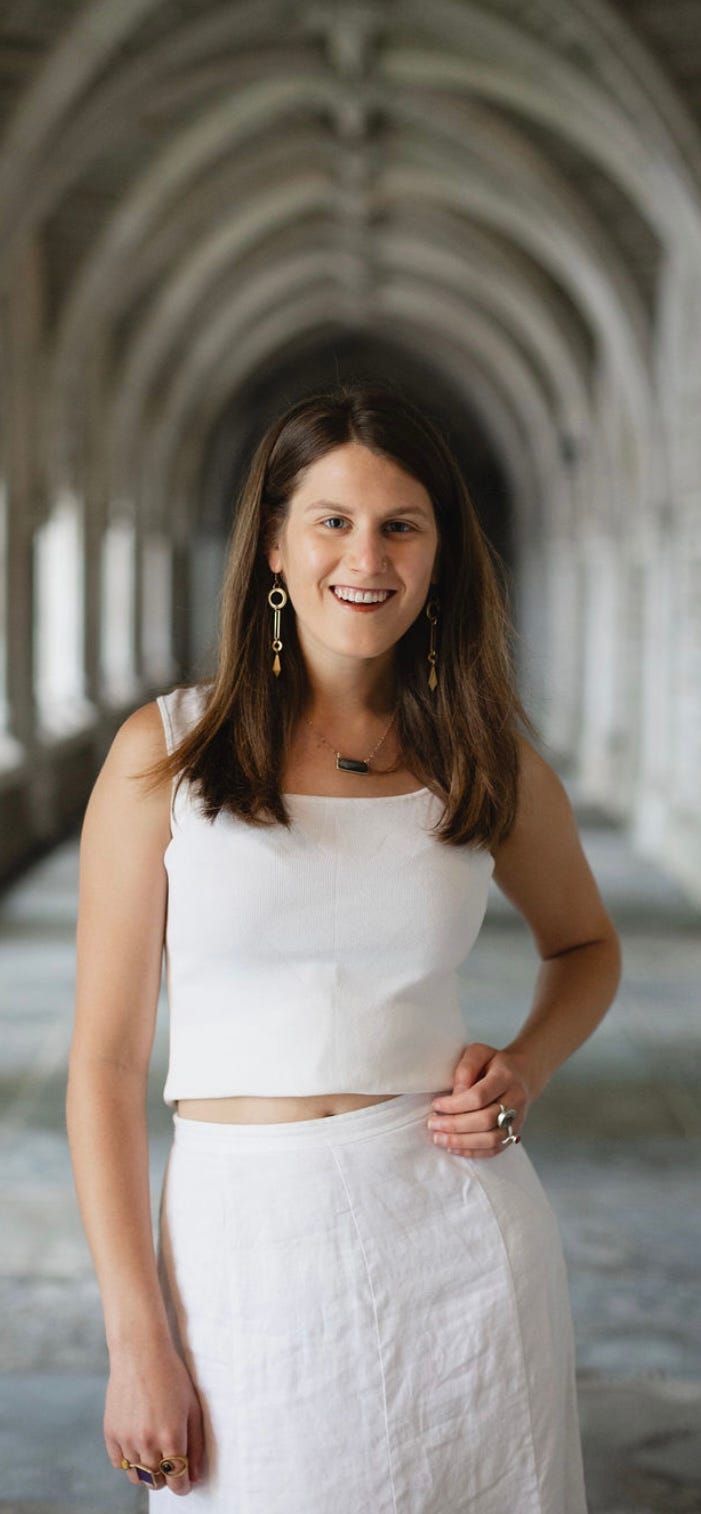
Emanuelle Sippy is a writer, organizer, and field coordinator with Achvat Amim, based in Jerusalem and working in partnership with Palestinian communities in Masafer Yatta. Her chapbook is titled The Place I Return. She begins a new cycle of solidarity work in October.