
HOPE: The performance of yours that has stuck in my mind forever is a solo set Aliyah Ultan invited you to play at one of her events. You brought a looper and your guitar, you lit some incense, and you created an entire world out of almost nothing. That performance really gripped me. I’ve been thinking lately about what I’m actually interested in now. I’ve been setting up concerts and having intense, visceral reactions to what I am and am not willing to do. A straightforward quintet set, something I would have said yes to without a second thought a few years ago, now makes everything in me refuse. I’m in a more ceremonial realm now, where I want a scaffold of really clear intentionality for an improvisational world. There’s a very narrow window in which the portal I’m willing to give everything for exists. I think that ceremonial space is what you created in the set I’m referring to, either naturally or with great intention.
So: where do you find yourself in this exact moment, physically, spiritually, mentally?
KEY: First, thank you for shouting out that performance. It was an interesting, fun, experimental set. You mentioned intention and improvisation, and that has gradually become the foundation, the core sense of self I’ve discovered through music and artistic expression. People can look at it as noodling, as being all over the place, but there’s something to take from any experience if you allow yourself to be open to it. I feel like I’m perpetually in that open space: structured in flow, structured in the improvisation of life and music. When we think of improvisation, we think of doing whatever comes without thinking. And in spiritual practices like Buddhism, so much of the philosophy is about not thinking, about not attaching something to every thought. So that’s where I find myself: being really present, allowing things to flow, and having grace and gratitude, even in the moments of frustration. There are projects I want to complete, and sometimes I feel I’m taking a long time on them, but I’m going to accept the pace that I’m at. When I’m called to work on pre-existing projects, I allow myself to be called. I also teach, so a lot of my time is spent creating music to engage children, and finding the beauty in that. It’s honestly everywhere. I find myself merging it with my lifestyle.
Structured in flow, structured in the improvisation of life and music.
HOPE: In yoga science they talk about the ten bodies. Your physical body is the last of the ten, the slowest; by the time a change lands here, it has already moved through all the other energetic bodies. In the world of improvisation, especially for people with access to a sophisticated sense of their own sensory system, you can’t rush anything. It lands in the physical realm when it lands. And when you said grace, I thought: grace is a daily practice. I wonder how Key practices grace. What have you found helpful? What are the guardrails?
KEY: I’m the kind of person who has had to learn through experience. People say they learn the hard way, and that has been a lot of my lessons: having to literally live a thing in order to experience the other side of it, the polarity of it.
HOPE: What’s an example?
KEY: Rushing music, and not slowing down in general. People talk about burnout, and I’ve definitely experienced that through school and college.
HOPE: What does burnout feel like to you? We’re a burnout culture, after all.
KEY: It feels like slowly spiraling downward. But I just saw a quote that said a downward spiral is a loaded spring, ready to release. At a certain point you have to feel all of it, and then surrender. So surrender is a daily practice, and so is accepting where things are. In terms of practical things, I’ve been working out. I like to stretch.
A downward spiral is a loaded spring, ready to release. At a certain point you have to feel all of it, and then surrender.
HOPE: Are you a gym bro? I’m a gym bro now. It’s my new spiritual practice.
KEY: I’m trying to be a gym bro. We live really close to a YMCA here in Philly, and our insurance granted us a free membership, so I want to take advantage of that; so often the cost of resources is the obstacle. And you mentioned the physical body being the last of the ten. I saw a quote recently that said working out is a spiritual process disguised as a physical one, and I’ve found that true of yoga too. I still do yoga and meditation, but honestly the working out feels like it’s all a meditation. Spirituality doesn’t look one way. I’m a big advocate of that. People make it seem like it has to look a certain way, routinely, and my routines shift a lot. There was a time I dedicated an hour or two of guitar practice a day. Sometimes I’m in that phase, and sometimes I’m out of it; I simply don’t play, and whenever I do, I let my prior knowledge and the present moment guide me. I think about Lauryn Hill, who said that so much of writing great music is that you have to live, that you have to have lived an experienced life to have something to write about. Plenty of people have the natural gift of playing or singing, but how we express it comes from our experience: the struggles, the triumphs, the laughs, the tears. So I just live. Sometimes I’m deep in my guitar practice and it’s really cerebral. Right now it’s my body and my mind, and it all informs the music. Where I am right now is a mixture of things, and that’s almost always the case.
HOPE: The word that keeps coming to me is multitudes. Do you have Scorpio somewhere in your chart?
KEY: I’m a Gemini with a Scorpio moon, yes. Miles Davis was actually a Gemini sun with a Scorpio moon. RuPaul is the reverse, a Scorpio sun with a Gemini moon.
HOPE: He’s a great example. That combination is very familiar to me. A lot of my closest people have some version of it, and I find they’re constantly misunderstood. Everyone feels misunderstood in some capacity, but this is an almost endless incapacity of other people to fully perceive that combination of energies, which is tricky to walk with but it’s a good energy to posses for our times though. Right now it feels like some kind of portal is opening: everything breaking apart; what used to be foundational (all the old rule systems) has become irrelevant etc. We’re all poised for the new world with no clue what the new world is but we’re all like runners in the starting blocks, before the starting gun goes off.
I used to spend a lot of time thinking about what makes great music; now the question has shifted to what makes a good life, a great ceremony, a very effective ritual. I used to think what makes a great musician is generosity, and I still believe that. When I experience an excellent offering, it’s always from a place of generosity. No one had to give that much, it’s beyond the price of the ticket.
When a concert is doing the thing, touching all the taste buds like a perfect meal, there’s a scaffold underneath: a timing, an arc, a lot of craft, and also a lot of space for each thing to fully develop, It’s a capacity to hold a charge of that ceremony.
I think about meditation as a musician, body work as a musician, building the capacity to run different energy currents. I think a lot about voltage. People who have a lot of impact can run a certain voltage without it burning them out. It’s like weightlifting: can I run this current, in this moment, without collapsing? When music hits me that hard, I know someone has been working on a bunch of invisible realms for it to run through me like that.
KEY: You have to think about how much time, effort, and energy culminated in the moment you’re witnessing. That helps with not taking it for granted, with being truly present with the experience and, hopefully, grateful for it.
HOPE: We’ve talked around openness, and I think the capacity to be open in a moment like that is something you train. How do you think about it?
KEY: It comes from experience. I’ve been playing music for eighteen, almost twenty years, and I’ve had all kinds of experiences; I’m sure there are more I’ve never had. There always are. I’ve had to learn that when I try to control the music too much, it doesn’t serve the music or its purpose. I’ve had experiences as a bandleader. It’s interesting that Miles Davis comes up again; I’ve heard stories about him as a bandleader, and some of them aren’t pleasant. I’ve been there, not to that extent, but I know conflict resolution.
HOPE: You’ve been bringing this up a lot recently.
KEY: It’s a forever lesson for me. I want to be able to say I’ve got it, but I don’t think you ever really get it. There’s always more wisdom to obtain. I’ve had to embrace humility and surrender, even the feelings I don’t promote: shame, guilt, all the really uncomfortable things. We talked about the downward spiral as a loaded spring. Sometimes you get to a point where you feel you’ve tried everything, and you might have destroyed things in the trying, because you desired something so much that you held on too tightly to a thought, a belief, a way of life, a way of doing things. That is what catapulted me into having no choice but to be open. Because that’s really what a lot of music is: conversation and relation, a dialogue between however many beings are present. So I’ve had to go from one polarity to understand the other, and then find a balance. It doesn’t mean I’m so open that ideas simply come and go. If I’m compelled by something, I try to honor it, and I devote the time and effort it requires to see it through to the best of my ability. If I’m unsatisfied, I give myself grace and stay open to pivoting. It’s a daily practice.
HOPE: You keep bringing up the word grace, which I think is really cool, because grace is not something most of us are trained to practice with ourselves as children. We’re raised in a shame-and-punishment culture. School is mostly a shame-and-punishment culture, and even outside of school you’re in capitalism, which is a shame-and-punishment culture. It’s insidious: we police ourselves. The voices got infiltrated and now we think they’re our own. You have to be faster, better, prettier, richer. And it’s like, my God, no one is even talking to me right now… I just took on those voices and beat myself with them.
The last era of my life has been on the path of a single prayer I made, a devotion to this idea of an inner compass. I wasn’t sure intuition was the right word. There’s a very quiet, meek, directional thing, and every once in a while I hear it nudge. The suggestion is always left field, never practical, never in agreement with the advice of the people I think I should listen to. But every time I’ve followed it, it has led me to incredible places. So I thought: I want to make more space for her. I want to figure out how to make her the leader.
KEY: Make her louder.
HOPE: Yes. And maybe that’s what grace is. It seems like you have something there.
KEY: That’s interesting, because I looked up the meaning of my full name, Keyanna, and it actually means grace. I’m really into etymology, the origin of words and names, so you’ve got me thinking. What you described, the guilt and shame, is so deep-rooted. It’s tied to my experiences growing up with my mom and my siblings in Brooklyn, and she experienced a lot of it in her own upbringing in Jamaica, a whole different place and time. That’s how deeply systemic and conditioned these things are. I feel grateful to be where I am now. We have access to so much, and as much as the internet and social media can be a lot, ultimately it’s a tool; it depends how we use it. I’m definitely sometimes doom-scrolling. No shame out here. Grace and awareness. But I’ve also learned so much, met people, and been open to suggestions I wouldn’t have had access to in the same way from where I was living. It’s important for me to give that grace to myself first and then extend it to others, because that’s part of community and how we show up. You can’t pour from an empty cup. I’ve learned lessons around that: depleting myself, self-sacrificing, thinking I’m a good person because I’m doing so much, performing goodness.
I started street performing when I was fifteen, in high school. It was one of the first times I was making money on my own doing something I loved, to the point where I could help with expenses at home. Mostly my phone bill. But there came a point where music, something I love, became a source of income, and I would give up my love and energy for the music to have opportunities, chasing this illusion of making it. It’s tied to capitalism just as much as anything else, even if it doesn’t feel that way because it’s music. The industry part of it is very deceptive.
HOPE: It’s a great hypnosis. And somewhere in the last five to seven years I’ve watched that self-policing, the shame we inherit around our bodies and our temperaments, extend into the experimental music scene in a different way: people policing themselves to be more likable. And I’m like, where are the rebels? Why are you in music like this if you’re not trying to make a space where you can say, like me or don’t like me, this is my mission? Not to go make enemies; just the idea that you might not like this, and that’s fine. Instead, somehow, everything became beige. If there were a couple of beige items up in here, fine. But the rule became: no one be offended, no one offend anybody. And I’m thinking, this is the wrong place for that. The fire is gone. Not to confuse this with what you were saying about decorum. Decorum matters; we’re all in this together. But decorum with no teeth means no one is saying what they actually think or feel. Everything becomes a lie so that no one gets bothered. It’s like the couple who’ve been together too long: no one’s having sex, no one’s even fighting anymore. They’re just ignoring each other. You’re not relating.
Decorum with no teeth means no one is saying what they actually think or feel.
KEY: Why are we here, you know? And these things take their own time. Lauryn Hill again: I think that’s part of what she was saying in her Grammy speech. For her to make The Miseducation of Lauryn Hill, that was her raw truth, her most honest, authentic self, and part of it was what she had lived. Maybe that’s why we only got the one album. She talks about how, if she had gone right back into the studio to capitalize on that stardom, it might sound good, but you won’t feel it. It won’t come from a place of I have felt this to my core, and that’s why I’m saying it.
HOPE: It’s like a manifesto. I was reading the Surrealist manifesto right before this call. People suggest all these writing structures; in academic writing you’re told to find someone who believes something you think is untrue and argue them wrong. I could not care less about doing that. So what forms match what I’m interested in? I really like sermons. I like certain manifestos. And I think the album-as-manifesto is a cool way to treat your work, though maybe an overwhelming one, to spend the whole time you’re making it thinking, if I leave here now, what do I want to leave my people?
KEY: I think about that a lot, I can’t lie: mortality, legacy. Sometimes the thought passes with a bit of anxiety, or concern rather, a feeling that I haven’t done enough, at least in the realm of music and the industry. But I have to remind myself that this whole ideology, this industry, predates me. I don’t have to subscribe to it as the marker of legacy and success.
HOPE: I think that’s the revolution right there. The industry is completely different than when we were coming up.
KEY: It’s crumbling, for sure, slowly crumbling. There are cracks.
HOPE: But we’re still battling the ghosts of structures. There’s an open space now that’s very exciting, the chance to say, here’s what success means for me. Or even: here’s a model for how we survive. That would be a great first move. But those ideas are tricky, because even as I spend my time imagining new futures, the old voice still pops into my head like an attack: okay, you can do that, but you still haven’t reached that many ears, that many views. The who-do-you-think-you-are voice. Maybe it’s the shadow our generation will always walk with, being the transitional generation. Maybe it never goes away and we simply learn a new relationship with it. Maybe we treat it like a senile uncle: okay. Thank you.
KEY: That’s funny, actually. But this is literally what we’re describing: the emergence of the Pluto in Aquarius transition, the twenty-year cycle we’re in now. Pluto is death and rebirth, Scorpio, as you know. We’re seeing the shadow of what came before, Pluto in Capricorn: structure, responsibility, work ethic, martyrdom, what you leave behind. Now we’re in the rebirth through Aquarius: innovation, freedom, humanity, progression. Free-spirited and revolutionary, like you said. I feel it.
HOPE: Those energies are really different to absorb. Capricorn energy can be very reliable, but it can get stagnant, depressed, and stuck. It’s the builder, but it can lose the thread.
KEY: And the structure, over time, as the world turns, literally, may start harming the people it once helped. Or maybe you learn the structure never helped people to begin with, or that it only ever helped some. The structure is run by the elites. It’s all the same shit, without saying too much.
HOPE: You can say anything you want here. But the Aquarius energy, that Uranus energy, is immediate change, and something lulled us into believing things have to be predictable and measured. There was a Capricorn in my life, who I won’t name, who is also into traveling, but we’re completely opposite in how we approach it. For this person, you read the travel books, you make the plan, and everything is set before you arrive. And I was like, do not put that book in my face, I will throw it at the wall. I show up, I meet people, I see where they tell me to go. That’s what’s enjoyable: not knowing what’s going to happen. The discovery.
KEY: That’s probably the realest, most authentic experience of it. Think about our ancestors, traveling and migrating: all they had was the moon and the stars. They wandered. So much of what has become a thing came from stumbling upon it, not intending it, and then finding meaning for it once you’ve arrived.
HOPE: I’ve been thinking about really honoring mystery, making space for mystery. The current title of my thesis is Beyond Our Understanding, which is kind of a crazy approach to a thesis: yes, we don’t know. But this goes to that Aquarian energy of our age: Everything is different, immediately, and now, and you have to be quick on your feet. It seems like the thing to train for our future, which is actually just here, now, is how quickly you can change your perspective. How quickly can you change your mind? Not in a scattered way, but in the sense that what is here is now different, so respond to what’s here. It changes again; respond to what that is. For me, right now, the practice of music is a tangible, miniature version of that, like the little shoebox houses you’d make as a kid, where you look through the hole into a little world. How can I create a structure where I can respond quickly to any change, held in certain bookends and rule systems? It’s like designing games. How do I take these huge topics, surrender and grace, and make a little training system, a little gym?
KEY: I talk about that all the time. I like to tell people I’m hacking my brain, though really it’s reprogramming, because a lot of what we’re learning, we’re also unlearning: discovering that what we thought or believed is actually not true. A lot of learning isn’t anything new. It’s learning, unlearning, and maybe relearning. For me that looks like talking to myself, out loud or in my head, and writing notes on boards, making the words visual. Words are important to me, and seeing them has helped me manage my time and my tasks. Systems are important, systems that serve your well-being and help you accomplish your goals: making sure I’m in a good headspace, that my body feels good, that what I’m thinking about is generally pointed toward something positive, individually and collectively. Living with my partner is part of that. When you live with someone you’re that close to, that vulnerable with, there’s a mirror happening day to day. You can shut down and refuse to deal with it, or you can accept that this is what you’re being shown and respond to it in the moment. We’ve cultivated a lot of compassion around that, and forgiveness, and open communication. Communication is itself a system, and then you can communicate about systems.
That includes music. For a long time music felt like an obligation: I’ve got to get better, I’ve got to get better. Now I love music in all capacities, even when I’m not practicing it. That’s been some of the relearning, getting back to why I started, why I fell in love with music. Going through conservatory and through the world, it’s easy to forget. I might literally write it on the board: remember why you fell in love with music. However many times I need to see it, I’ll project it onto my walls.
Remember why you fell in love with music.
HOPE: What is your relationship with music right now, and maybe the guitar specifically?
KEY: That’s such a loaded question. It’s ever-changing. Right now I don’t play guitar every day. When I was in school, surrounded by musicians, I played every day, and even after college I lived with musicians in New York, which was a great motivator to practice as much as possible. That’s great, but it’s not all there is to life. I learned about one jazz musician who took a seven-year hiatus from their instrument. Having studied jazz, knowing how deep that language is and how deep the pursuit is, hearing that someone took a break and came back and was still acknowledged, still making great music, validated something for me: I can go at my own pace.
Right now it’s a lot of things. I still freelance, and it provides me income; I understand that. And because it’s a source of income, I intentionally make space for time that’s purely creative, for fun, for trying new things, for messing around and finding out. I have to remind myself of that, because the world can get pretty cynical and routine: go to work, play the gig, get the money. Before I know it, I haven’t catered to doing it just because I love it. The weird thing is, I still love it in those moments. I love performing. I love being on stage. But I also know this is how I’m paying my rent and my bills. That makes me want to play to the best of my ability, because it can lead to more opportunities to sustain myself, while also balancing it with the reminder: don’t just think about it like that. You love it. Put your heart into it. Make space for that curiosity to keep being nourished, to flourish.
And I’m in a good space. Here in Philadelphia I have a room dedicated to making music, which I have never had before, ever. In New York, wanting to stay in my hometown and affording what I could afford, all I had was a room to exist in, to sleep in, trying to feel at peace amidst living with people I didn’t agree with. There’s the whole diamond-in-the-rough idea, that tough times can birth something great. But I don’t want to be in that space anymore. I shouldn’t have to take that. I want to be at home, peaceful, free, liberated to go at my own pace. I’ve never had that experience before, so I’m still a little in awe: wow, I’m here, I really have all this room. So I’m not in a rush.
But things are happening. I’m creating just to create, and I’m working on an EP that I’ve been making for two years now. It’s essentially the music I’ve been playing with my trio, Key Hutch. We recorded all the instruments at a studio in Brooklyn; it will be two years this fall. My friend Carlos Truly engineered the session and helped produce and mix some of the songs. It’s something I’ve been wanting to complete. Lately I’ve been veering off into a very free, flowing vibe, moving away from it, but I know it’s there. I’ll come back. I don’t want to shame myself into “you have to come back,” while still staying aware that I did set out to do these things. I have friends holding me accountable, asking when I’m dropping this music, and sometimes that outside pressure reminds me that people care. People are anticipating. I don’t want to let down the people who support me.
HOPE: Can I share the image I got while you were talking? My brain works in images. You know how a plant grows: there’s the first stalk that builds, and then suddenly a branch shoots out sideways, completely left field. To me that means this is a really big tree. This is not a little tulip, one shot and then it opens. It’s surprise, surprise, surprise. I see this in your growth spurt. And one thing you said, space for curiosity: space for curiosity does not support our current system, so it isn’t encouraged. I always feel I have to defend curiosity. Not as a fight; more that I have to put a ring of fire around an empty space, and anytime someone comes along asking what that empty space is over there, I say, don’t touch it. That’s the open space for curiosity, and you do not build there. It’s a no-build zone.
KEY: People want to define it, to put something on it. I think you understand, because you’re a Pisces. Mutable energy, which I relate to; I have Gemini and Virgo placements. There’s been a lot of shame around that, people making me feel I have to choose one thing, have it all in order, have something built by a certain time, something to show for myself. I’ve been in a season of reclaiming: releasing that shame and accepting that the mutability is the power. It’s powerful.
I’ve been in a season of reclaiming: releasing that shame and accepting that the mutability is the power.
HOPE: And for artists to come back into being the authority over their own creative process. Not to put it on other people; just to say, if you’re coming to me for sauce, I’ll tell you how the sauce is made. Don’t tell me how to make the sauce. If you want a different sauce, go to a different sauce maker.
KEY: This is how we do things over here.
HOPE: And this is an experimental test kitchen. If you don’t like experimental test kitchen vibes, go to McDonald’s, go wherever you get the same thing every single time. But learning to rebuild that sense of authority, of self-authorship, is really tricky. People make it sound simple: just have confidence, just stand up for what you believe in. There are so many things that have to be unraveled before that can even be a concept, so many structures we adhere to for a sense of safety that ultimately don’t keep us safe. It’s a lot of work on your subconscious to be able to stand up to, say, a session studio owner and say, this is not how this is going down, while your brain is screaming that you’re going to lose your reputation, the money you paid for the space, your survival.
KEY: That has happened to me, and I think it’s my energy too. I’ve recently been learning about Lilith, the deity, but also in astrology, where it represents the places we’ve been outcast, where we might feel rejected. There’s been a lot of misunderstanding around that area for me. I’ve always been the one to name the elephant in the room. People are thinking the same thing I’m thinking; I’m just the one who says it out loud, directly, and then I’m made the problem for saying the truth.
HOPE: Which is the artist’s job, in my opinion. If you’re not doing that, are you an artist? What does James Baldwin say? “If I love you, I have to make you conscious of the things you don’t see…” That’s the job description. Somewhere along the way a weird new job description crept in: make your audience happy, make sure everyone is pleased with your performance. That’s a different job, and somehow we’ve conflated the two.
KEY: That’s what being an artist is. But artists of the music industry are in a different position, because the industry has to make money. Anything you bring attention to that might infringe on the process of making money hurts that, and that’s why the people who walk those paths are so often marginalized. They don’t get the same support, the same representation, the same visibility.
HOPE: I do feel like times are changing, though. I feel it in my bones. I feel like I’m looking at a sinking ship with a bunch of people scrambling on it saying, but this is how we make money, and I’m saying, your ship is sinking. There’s an iceberg here and a shark there; these are just the facts. In the eighties, okay, you’re rolling in the dough; I kind of get it. But now we’re fighting over scraps of a hundred and fifty dollars that doesn’t even buy groceries anymore. The conversation is completely illogical. This is where the paradigm is actually breaking, and I think the seeds are in education. I was just talking with a mentor of mine, Tyshawn Sorey...
KEY: I just played with him, actually. That’s crazy.
HOPE: The first time I saw him play, I didn’t even know who he was. There was transcendent music happening and I couldn’t tell who was leading, and to me that’s very exciting. It’s very hard to keep something that tight with no visible leader. Chef’s kiss. So I went to meet him afterward, and we’ve kept in touch ever since. He’s one of those people who is for real a helper, who does the right thing when no one’s looking.
We were talking about the generational standoff in this music right now: older musicians saying no one’s good enough to sub for them, young people saying, you’re all holding on to the jobs and not giving us a shot. Ageism in both directions. I think the root is in education. We’re taught, as teachers, that students are empty vessels you fill with information, instead of asking, what if education is a dialogue? Here is this incredible being, full of things they could teach me, full of perspectives I could benefit from. It’s so hierarchical, the patriarchal model of oppressive knowledge. Of course that feeds into our music, because that’s how we teach music: I know and you don’t, so do it how I do it. There’s space for those elements, but when it’s your entire model, we end up wondering why we’re not communicating and everyone hates each other. You dehumanized the young generation, and then they grew up and dehumanized the next one.
KEY: Education should be more of a dialogue, where we’re learning from each other. It’s intertwined with music for me, because I teach music. Just yesterday, teaching was tougher than most days, getting everyone’s attention, keeping the focus, and for a moment I felt myself getting frustrated and had to breathe through it. There are just some days. Especially because the first week was really good; the kids were engaged, and one kid even hugged me. I teach a ukulele class, actually. I feel like a kid myself. I feel very childlike, so I try to engage with actual kids in a way where they can feel that we’re equals in a lot of ways. We share youth. My capacity is different, obviously, a different stage of life, but I tell them: I get you, I hear you, I understand you. You don’t always get it right, but I try to. And I’ve noticed it makes for a better experience, being really curious in a kind of serious, unserious way: taking seriously what each other says, valuing each other’s right to speak and share an opinion, and also being unserious, finding the joy despite the age gap.
There’s a nonprofit I’ve been working with in Brooklyn, Willie Mae Rock Camp, and one thing they emphasize for teaching artists is shifting feedback from what you like to what you noticed. If you say you like one kid’s presentation, you’d better like all of them; children have big feelings at a young age. I have a game I play with the kids, kind of like hot potato with music. I call it pass-the-marker, and sometimes a kid loses a round and cries. It really hurts their feelings. So to see an organization making that initiative with young kids, at a pivotal time in their lives, is really powerful. It makes me reflect on when I was a kid doing music class, being in orchestra, which can be very rigid, and wishing I could have had those experiences. Or rather, being grateful that I can give that back, and staying aware of how the old ways can perpetuate shame and guilt.
HOPE: I like that you said stage of life, because each stage has a different quality of perspective, naturally. It’s not that you gain value as you age; each age has a different, valuable perspective. And we’ve lived in nuclear families for so long, so isolated, that you stay in your own age bracket forever. In high school, everyone’s your age. In college, everyone’s your age. In corporate life, everyone’s your age. Instead of always being around children and always being around elders, which really shifts you.
KEY: I think it helps with understanding humanity as a whole, which matters, especially in this transition. We’re seeing a reconstruction of humanity. Most of the world has been under heavy capitalist ideologies and systems, and you see that crumbling. Now people are returning to community spaces, to DIY, to doing things together.
HOPE: And we’re all like, shit, we don’t have these skills. Let’s be in community! Wait, we don’t know how…
KEY: Which is why I’m literally thinking about skill-building: what are the ways I can access more freedom in this realm? I want to learn how to drive. And there’s a community garden down the block from our house where we volunteer. We’ve been growing so much: bok choy, kale, lettuce, garlic, and herbs like lavender, yarrow, and calendula. There’s a fig tree and some strawberries, and they let us take from the garden too. Growing food is really important, being connected to how we actually live and sustain ourselves. We’re so disconnected in this society. People say, I could never kill a chicken. Okay, but the dead, sliced-up parts are packaged nicely for you in an aisle somewhere, and you have no problem taking that.
HOPE: This is my dream too, to build a retreat center for musicians, artist residencies, living on the land, Black Mountain College style. Hearing you talk, I keep thinking that the task of spiritual and emotional processing has been handed to artists. But we removed artists from the whole, from growing food, from being connected to different generations, the very things that teach you about life, and then said: okay, you separated, isolated people are the artists now; do the social-emotional work of holding all of us. But you took us out of the environment. We’re not going to make helpful things in a completely non-holistic environment.
KEY: That’s the product of where we’ve been displaced. People have written whole songs about wanting to go home. Think about the blues: it’s music, but it came from the experience. Art always reflects the times, I believe. It just naturally does, whether we believe it or not. It’s a stronger force we’re tethered to.
HOPE: But do you feel like everyone’s tapped into it? A lot of people talk about a split of dimensions. I’ve heard a couple of channels say the split already happened a few years ago, maybe your Pluto thing, and that eventually there will be two sets of people who won’t even be able to perceive each other. Because when you say respond to the moment, I see people technically responding to the moment, and I think: what is the moment for you? Are you on a different planet?
KEY: I feel like that’s true. It’s based on context. I’ve been loving Threads lately, a nice breakaway from Instagram, which is whatever at this point. I have people on there from all walks of my life, and sometimes I experience exactly what you’re describing. There’s a term that’s been popping up, monitoring spirits: people just watching what you’re doing without ever truly engaging. Like the couple you mentioned, living together, no sex in two years, no fighting, just existing. Why are you here? What are you here for?
HOPE: I see it most clearly in relationships. It’s as if a certain script is still running through people’s minds while the world has completely changed. They have an idea of what’s going to happen, and I think: that world literally does not exist anymore. What are you responding to? You can’t relate to me if that blueprint is still running. It’s a huge split, and it’s really bizarre to be inside of it.
KEY: I see it too. It’s definitely apparent. And your mentioning scripts made me think about programming. We’re all programmed from early childhood: systems, school, the whole thing. A lot of people hold tightly to whatever programming they’re used to, maybe out of fear of the unknown, or because they don’t believe any other script will work. Full compliance.
HOPE: It takes a lot of energy to make a change. That’s something I’m constantly humbled by; I get why people don’t change. The program runs so smoothly, so seamlessly.
KEY: But I feel like for people like us, water and air as far as our elements go, the change is seamless in the other direction. People are thrown by it: how could you just switch up? How could you think that, and now think this? Well, Pisces is a lot about how you feel, and your feeling can change in an instant, because you simply feel differently. That is your birthright. Gemini is more about information and thinking; what I think, what I believe, can change in an instant based on new information. I don’t get into the pop astrology. I try to understand every sign for what it’s meant to bring us, to teach us, without biases. But a big practice for me, with all of this, has been boundaries. And here’s a quote I shared years ago that you just made me think of. It’s from Wayne Shorter, one of my favorite composers: your humanity is your instrument. Sometimes I switch the words, because I’m paradoxical like that: your instrument is your humanity. You can see it from both directions. I shared it so long ago, in my early twenties, and over time I learn and grow and come back to it with new meaning, new understanding. And it’s this conversation we’ve been having, about ritual and artistic expression. It’s all of it.
Your humanity is your instrument. Sometimes I switch the words: your instrument is your humanity.
HOPE: So, what’s coming? Where can people find you and what you’re making?
KEY: Right now Instagram is my primary place: @key.hutch. That’s the best way to reach me and to catch announcements. I’m performing out here in Philly and in New York, and I’ll be updating there about the music I’m working on and the music I want to release. And offerings, day-to-day offerings, the multitudes of me: the music, the astrology. I’d love to find a way to create offerings that connect the two. I’m in a transitional period right now, so stay tuned. And thank you, Hope, for thinking of me for this conversation. I appreciated how you were able to articulate and respond to what we’ve been talking about, in the moment. That’s a task, for real.
HOPE: And here at the end, how do you feel?
KEY: I feel good. I feel really peaceful. My nervous system, which I’m learning about a lot every day, feels at a state of regulation. I say that carefully, because it’s easy to adopt words from the internet and think you know something. I’m always ready to learn; I try not to attach too hard to thoughts, words, and beliefs. But I feel at the most peace right now that I’ve ever felt in a home space. Interestingly, we’re in Cancer season, which has themes around home: where we’re most vulnerable, where we can build an emotional foundation for how we create and how we do things. I’ve never experienced this sense of it for a long period of time until being here, and I believe it’s going to help with what I’m creating, what I’m cultivating. Because for one, the soil is good. It’s not contaminated. It’s not dry. It’s moist.
It’s gonna happen. The pace of the process.
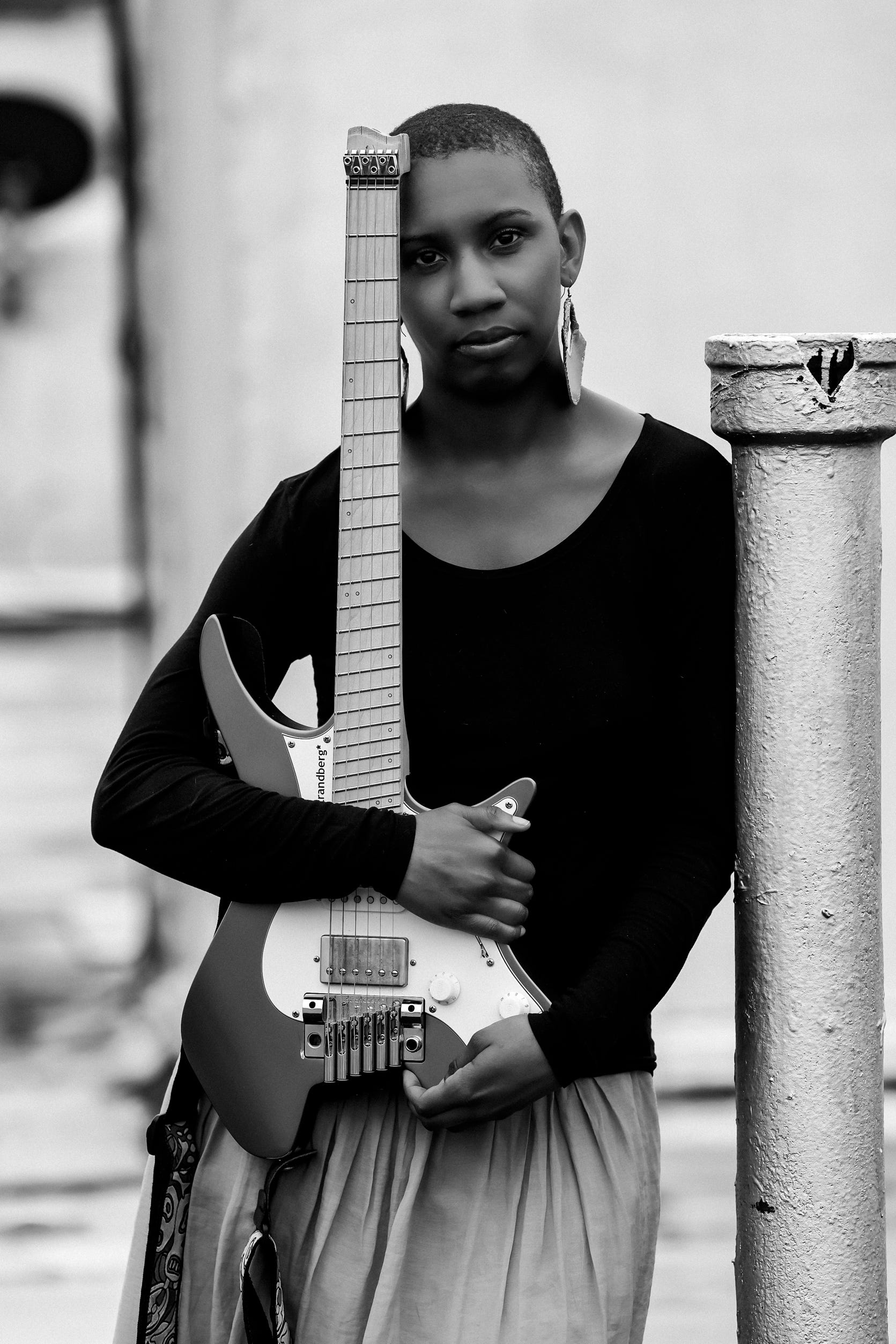
Key Hutch is a guitarist, composer, and teaching artist based in Philadelphia. Their debut EP, recorded in Brooklyn, is forthcoming. Find them at @key.hutch.
such a beautiful flow of conversation! this all gave me much to think about with my own artistic rituals and how the physical practice sometimes revitalizes the spirit. thank you both!!